Ch 24: Gauss' Law
Knight Calc - Physics for Scientists and Engineers 5th Edition
Knight Calc5th EditionPhysics for Scientists and EngineersISBN: 9780137344796Not the one you use?Change textbook
Chapter 24, Problem 29

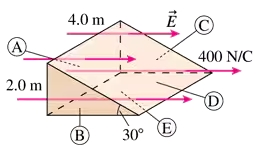
Find the electric fluxes ΦA to ΦE through surfaces A to E in FIGURE P24.29.
Diagram showing surfaces A to E with electric field lines and measurements for calculating electric flux.

Verified step by step guidance
1
Identify the concept of electric flux (Φ), which is defined as the product of the electric field (E) and the area (A) perpendicular to the field, mathematically expressed as Φ = ∫ E · dA. If the electric field is uniform and the surface is flat, this simplifies to Φ = E * A * cos(θ), where θ is the angle between the electric field and the normal to the surface.
Examine FIGURE P24.29 to determine the orientation of each surface (A to E) relative to the electric field. For each surface, identify whether the electric field is perpendicular, parallel, or at an angle to the surface normal.
For surfaces where the electric field is perpendicular to the surface (θ = 0°), the flux is maximized and simplifies to Φ = E * A. For surfaces where the electric field is parallel to the surface (θ = 90°), the flux is zero because cos(90°) = 0.
Calculate the area (A) of each surface if not already provided. Use the given dimensions in the figure to compute the area for each surface. For example, if a surface is rectangular, A = length * width.
Substitute the values of the electric field (E), area (A), and the angle (θ) into the formula Φ = E * A * cos(θ) for each surface (A to E) to compute the electric flux. Ensure the correct sign is applied based on the direction of the electric field relative to the surface normal (positive for outward flux, negative for inward flux).

Verified video answer for a similar problem:

This video solution was recommended by our tutors as helpful for the problem above.
Video duration:
7m
Was this helpful?

Key Concepts

Here are the essential concepts you must grasp in order to answer the question correctly.

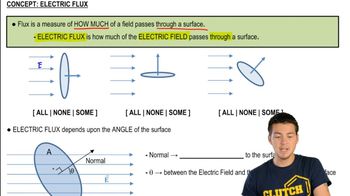
Electric Flux

Electric flux (Φ) is a measure of the electric field (E) passing through a given surface area (A). It is mathematically defined as Φ = E · A · cos(θ), where θ is the angle between the electric field lines and the normal to the surface. Understanding electric flux is crucial for analyzing how electric fields interact with different surfaces.
Recommended video:
Guided course
05:43
Electric Flux

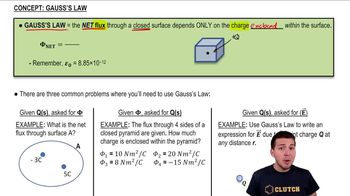
Gauss's Law

Gauss's Law relates the electric flux through a closed surface to the charge enclosed by that surface. It states that the total electric flux through a closed surface is equal to the enclosed charge (Q) divided by the permittivity of free space (ε₀): Φ = Q/ε₀. This principle is fundamental for calculating electric fields in symmetrical charge distributions.
Recommended video:

Surface Area Orientation

The orientation of a surface relative to the electric field significantly affects the electric flux through that surface. Surfaces perpendicular to the field lines will have maximum flux, while those parallel will have zero flux. Understanding how to determine the orientation of surfaces A to E in the context of the electric field is essential for accurately calculating the electric fluxes.
Recommended video:
Guided course
09:18
Equipotential Surfaces