
Ch 20: The Micro/Macro Connection
Knight Calc - Physics for Scientists and Engineers 5th Edition
Knight Calc5th EditionPhysics for Scientists and EngineersISBN: 9780137344796Not the one you use?Change textbook
Chapter 20, Problem 50

You are watching a science fiction movie in which the hero shrinks down to the size of an atom and fights villains while jumping from air molecule to air molecule. In one scene, the hero's molecule is about to crash head-on into the molecule on which a villain is riding. The villain's molecule is initially 50 molecular radii away and, in the movie, it takes 3.5 s for the molecules to collide. Estimate the air temperature required for this to be possible. Assume the molecules are nitrogen molecules, each traveling at the rms speed. Is this a plausible temperature for air?

Verified step by step guidance
1
Step 1: Begin by understanding the problem. The root-mean-square (rms) speed of nitrogen molecules is related to the temperature of the air. The molecules are traveling toward each other, and we need to estimate the temperature that would result in the given collision time and distance.
Step 2: Use the formula for the rms speed of a gas molecule: vrms = √(3kT/m), where k is the Boltzmann constant (1.38 × 10⁻²³ J/K), T is the temperature in Kelvin, and m is the mass of a nitrogen molecule (4.65 × 10⁻²⁶ kg).
Step 3: Determine the relative speed of the two molecules. Since they are moving toward each other, their relative speed is approximately twice the rms speed: vrelative = 2vrms. Use this relative speed to calculate the time it takes for the molecules to collide.
Step 4: Relate the distance and time to the relative speed using the formula: vrelative = d/t, where d is the initial distance between the molecules (50 molecular radii) and t is the collision time (3.5 s). Solve for vrms.
Step 5: Substitute the calculated vrms into the rms speed formula to solve for the temperature T. Compare the estimated temperature to typical air temperatures (around 300 K) to assess whether the scenario is plausible.

Verified video answer for a similar problem:

This video solution was recommended by our tutors as helpful for the problem above.
Video duration:
7m
Was this helpful?

Key Concepts

Here are the essential concepts you must grasp in order to answer the question correctly.

Root Mean Square Speed (rms speed)

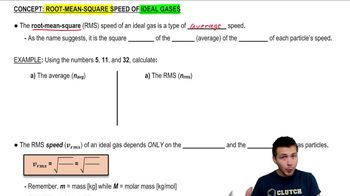
The root mean square speed is a statistical measure of the speed of particles in a gas. It is calculated as the square root of the average of the squares of the speeds of all the particles. For an ideal gas, the rms speed can be derived from the equation v_rms = √(3kT/m), where k is the Boltzmann constant, T is the temperature in Kelvin, and m is the mass of a gas molecule. This concept is crucial for understanding the average kinetic energy of gas molecules and their behavior at different temperatures.
Recommended video:
Guided course
05:21
Root-Mean-Square Speed of Ideal Gases

Kinetic Theory of Gases

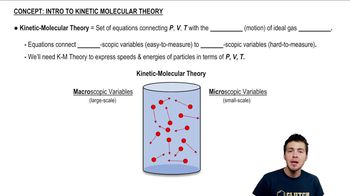
The kinetic theory of gases explains the behavior of gases in terms of the motion of their molecules. It posits that gas pressure is a result of collisions between gas molecules and the walls of their container. This theory also relates temperature to the average kinetic energy of the molecules, providing a framework for understanding how temperature affects molecular speed and, consequently, the dynamics of gas interactions. It is essential for analyzing scenarios involving molecular collisions and movement.
Recommended video:
Guided course
01:50
Introduction to Kinetic-Molecular Theory

Collision Theory

Collision theory is a framework used to understand how and why chemical reactions occur, based on the idea that molecules must collide with sufficient energy and proper orientation to react. In the context of the question, it helps to estimate the time it takes for two molecules to collide based on their speeds and the distance between them. This theory is vital for calculating the necessary conditions, such as temperature, that allow for specific molecular interactions to occur in a gas.
Recommended video:
Guided course
01:50
Introduction to Kinetic-Molecular Theory
Related Practice
Textbook Question

Uranium has two naturally occurring isotopes. 238U^{238}\(\text{U}\) has a natural abundance of 99.3%99.3\% and 235U^{235}\(\text{U}\) has an abundance of 0.7%0.7\%. It is the rarer 235U^{235}\(\text{U}\) that is needed for nuclear reactors. The isotopes are separated by forming uranium hexafluoride, UF6\(\text{UF}\)_6, which is a gas, then allowing it to diffuse through a series of porous membranes. 235UF6^{235}UF_6 has a slightly larger rms speed than 238UF6^{238}UF_6 and diffuses slightly faster. Many repetitions of this procedure gradually separate the two isotopes. What is the ratio of the rms speed of 235UF6^{235}UF_6 to that of 238UF6^{238}UF_6?

1
views
Textbook Question

A gas cylinder has a piston at one end that is moving outward at speed vpiston during an isobaric expansion of the gas. Find an expression for the rate at which vrms is changing in terms of vpiston, the instantaneous value of vrms, and the instantaneous value L of the length of the cylinder.

Textbook Question

Interstellar space, far from any stars, is filled with a very low density of hydrogen atoms (H, not H₂). The number density is about 1 atom/cm³ and the temperature is about 3 K. What is the edge length L of an L ✕ L ✕ L cube of gas with 1.0 J of thermal energy?

1
views
Textbook Question

Equation 20.3 is the mean free path of a particle through a gas of identical particles of equal radius. An electron can be thought of as a point particle with zero radius. Electrons travel 3.0 km through the Stanford Linear Accelerator. In order for scattering losses to be negligible, the pressure inside the accelerator tube must be reduced to the point where the mean free path is at least 50 km. What is the maximum possible pressure inside the accelerator tube, assuming T = 20℃? Give your answer in both Pa and atm.

1
views
Textbook Question

Photons of light scatter off molecules, and the distance you can see through a gas is proportional to the mean free path of photons through the gas. Photons are not gas molecules, so the mean free path of a photon is not given by Equation 20.3, but its dependence on the number density of the gas and on the molecular radius is the same. Suppose you are in a smoggy city and can barely see buildings 500 m away. How far would you be able to see if all the molecules around you suddenly doubled in volume?

1
views
Textbook Question

Photons of light scatter off molecules, and the distance you can see through a gas is proportional to the mean free path of photons through the gas. Photons are not gas molecules, so the mean free path of a photon is not given by Equation 20.3, but its dependence on the number density of the gas and on the molecular radius is the same. Suppose you are in a smoggy city and can barely see buildings 500 m away. How far would you be able to see if the temperature suddenly rose from 20°C to a blazing hot 1500°C with the pressure unchanged?

1
views