
Interstellar space, far from any stars, is filled with a very low density of hydrogen atoms (H, not H₂). The number density is about 1 atom/cm³ and the temperature is about 3 K. Estimate the pressure in interstellar space. Give your answer in Pa and in atm.
Photons of light scatter off molecules, and the distance you can see through a gas is proportional to the mean free path of photons through the gas. Photons are not gas molecules, so the mean free path of a photon is not given by Equation 20.3, but its dependence on the number density of the gas and on the molecular radius is the same. Suppose you are in a smoggy city and can barely see buildings 500 m away. How far would you be able to see if the temperature suddenly rose from 20°C to a blazing hot 1500°C with the pressure unchanged?
Verified step by step guidance
Verified video answer for a similar problem:
Key Concepts
Mean Free Path
Temperature and Gas Density
Scattering of Photons
A gas cylinder has a piston at one end that is moving outward at speed vpiston during an isobaric expansion of the gas. Find an expression for the rate at which vrms is changing in terms of vpiston, the instantaneous value of vrms, and the instantaneous value L of the length of the cylinder.
Interstellar space, far from any stars, is filled with a very low density of hydrogen atoms (H, not H₂). The number density is about 1 atom/cm³ and the temperature is about 3 K. What is the edge length L of an L ✕ L ✕ L cube of gas with 1.0 J of thermal energy?
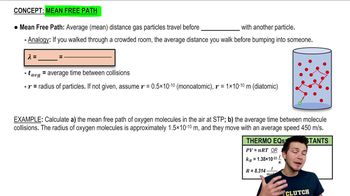
Equation 20.3 is the mean free path of a particle through a gas of identical particles of equal radius. An electron can be thought of as a point particle with zero radius. Electrons travel 3.0 km through the Stanford Linear Accelerator. In order for scattering losses to be negligible, the pressure inside the accelerator tube must be reduced to the point where the mean free path is at least 50 km. What is the maximum possible pressure inside the accelerator tube, assuming T = 20℃? Give your answer in both Pa and atm.
Photons of light scatter off molecules, and the distance you can see through a gas is proportional to the mean free path of photons through the gas. Photons are not gas molecules, so the mean free path of a photon is not given by Equation 20.3, but its dependence on the number density of the gas and on the molecular radius is the same. Suppose you are in a smoggy city and can barely see buildings 500 m away. How far would you be able to see if all the molecules around you suddenly doubled in volume?
You are watching a science fiction movie in which the hero shrinks down to the size of an atom and fights villains while jumping from air molecule to air molecule. In one scene, the hero's molecule is about to crash head-on into the molecule on which a villain is riding. The villain's molecule is initially 50 molecular radii away and, in the movie, it takes 3.5 s for the molecules to collide. Estimate the air temperature required for this to be possible. Assume the molecules are nitrogen molecules, each traveling at the rms speed. Is this a plausible temperature for air?
