
Ch 20: The Micro/Macro Connection
Knight Calc - Physics for Scientists and Engineers 5th Edition
Knight Calc5th EditionPhysics for Scientists and EngineersISBN: 9780137344796Not the one you use?Change textbook
Chapter 20, Problem 49a

Photons of light scatter off molecules, and the distance you can see through a gas is proportional to the mean free path of photons through the gas. Photons are not gas molecules, so the mean free path of a photon is not given by Equation 20.3, but its dependence on the number density of the gas and on the molecular radius is the same. Suppose you are in a smoggy city and can barely see buildings 500 m away. How far would you be able to see if all the molecules around you suddenly doubled in volume?

Verified step by step guidance
1
Step 1: Begin by understanding the relationship between the mean free path of photons and the number density of gas molecules. The mean free path (λ) is inversely proportional to the number density (n) and the cross-sectional area of the molecules (σ). The formula can be expressed as: λ=1nσ.
Step 2: Recognize that the volume of a molecule is proportional to its radius cubed (Vr3). If the volume doubles, the radius increases by the cube root of 2 (r=213).
Step 3: The cross-sectional area of a molecule is proportional to the square of its radius (σr2). Therefore, if the radius increases by the cube root of 2, the cross-sectional area increases by the square of the cube root of 2 (σ=223).
Step 4: The mean free path is inversely proportional to the cross-sectional area and the number density. If the volume of each molecule doubles, the number density remains constant, but the cross-sectional area increases. This causes the mean free path to decrease by a factor equal to the increase in the cross-sectional area.
Step 5: Multiply the original mean free path (500 m) by the inverse of the factor by which the cross-sectional area increased. This will give the new distance you can see through the gas. The factor is 223, so the new distance is 500223 meters.

Verified video answer for a similar problem:

This video solution was recommended by our tutors as helpful for the problem above.
Video duration:
4m
Was this helpful?

Key Concepts

Here are the essential concepts you must grasp in order to answer the question correctly.

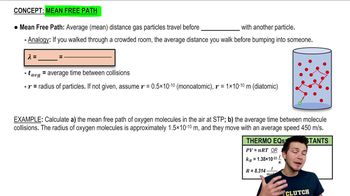
Mean Free Path

The mean free path is the average distance a particle travels between collisions with other particles. In the context of photons scattering off gas molecules, it is influenced by the number density of the gas and the size of the molecules. A longer mean free path indicates that photons can travel further without being scattered, which directly affects visibility in a medium like smog.
Recommended video:
Guided course
08:20
Mean Free Path

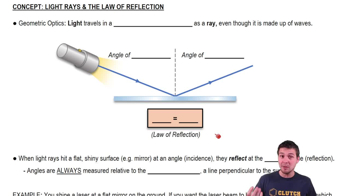
Scattering of Photons

Scattering occurs when photons interact with particles in a medium, such as gas molecules. This interaction can change the direction of the photons, reducing the distance they can travel before reaching the observer. The extent of scattering is influenced by factors like the size and density of the scattering particles, which is crucial for understanding visibility in environments with pollutants.
Recommended video:
Guided course
06:25
Law of Reflection

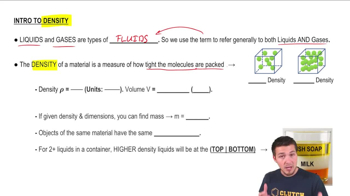
Number Density

Number density refers to the number of particles per unit volume in a given space. In the context of the question, if the volume of gas molecules doubles, the number density decreases, which affects the mean free path of photons. A lower number density means fewer collisions with gas molecules, allowing photons to travel further, thereby increasing visibility.
Recommended video:
Guided course
8:13
Intro to Density
Related Practice
Textbook Question

Interstellar space, far from any stars, is filled with a very low density of hydrogen atoms (H, not H₂). The number density is about 1 atom/cm³ and the temperature is about 3 K. Estimate the pressure in interstellar space. Give your answer in Pa and in atm.

1
views
Textbook Question

A gas cylinder has a piston at one end that is moving outward at speed vpiston during an isobaric expansion of the gas. Find an expression for the rate at which vrms is changing in terms of vpiston, the instantaneous value of vrms, and the instantaneous value L of the length of the cylinder.

Textbook Question

Interstellar space, far from any stars, is filled with a very low density of hydrogen atoms (H, not H₂). The number density is about 1 atom/cm³ and the temperature is about 3 K. What is the edge length L of an L ✕ L ✕ L cube of gas with 1.0 J of thermal energy?

1
views
Textbook Question

A mad engineer builds a cube, 2.5 m on a side, in which 6.2-cm-diameter rubber balls are constantly sent flying in random directions by vibrating walls. He will award a prize to anyone who can figure out how many balls are in the cube without entering it or taking out any of the balls. You decide to shoot 6.2-cm-diameter plastic balls into the cube, through a small hole, to see how far they get before colliding with a rubber ball. After many shots, you find they travel an average distance of 1.8 m. How many rubber balls do you think are in the cube?

1
views
Textbook Question

You are watching a science fiction movie in which the hero shrinks down to the size of an atom and fights villains while jumping from air molecule to air molecule. In one scene, the hero's molecule is about to crash head-on into the molecule on which a villain is riding. The villain's molecule is initially 50 molecular radii away and, in the movie, it takes 3.5 s for the molecules to collide. Estimate the air temperature required for this to be possible. Assume the molecules are nitrogen molecules, each traveling at the rms speed. Is this a plausible temperature for air?

Textbook Question

Photons of light scatter off molecules, and the distance you can see through a gas is proportional to the mean free path of photons through the gas. Photons are not gas molecules, so the mean free path of a photon is not given by Equation 20.3, but its dependence on the number density of the gas and on the molecular radius is the same. Suppose you are in a smoggy city and can barely see buildings 500 m away. How far would you be able to see if the temperature suddenly rose from 20°C to a blazing hot 1500°C with the pressure unchanged?

1
views