
Ch 20: The Micro/Macro Connection
Knight Calc - Physics for Scientists and Engineers 5th Edition
Knight Calc5th EditionPhysics for Scientists and EngineersISBN: 9780137344796Not the one you use?Change textbook
Chapter 20, Problem 41

What is the entropy change of the nitrogen if 250 mL of liquid nitrogen boils away and then warms to 20℃ at constant pressure? The density of liquid nitrogen is 810 kg/m3.

Verified step by step guidance
1
Step 1: Calculate the mass of the liquid nitrogen. Use the formula \( m = \rho \cdot V \), where \( \rho \) is the density of liquid nitrogen (810 kg/m³) and \( V \) is the volume (250 mL = 0.00025 m³).
Step 2: Determine the entropy change during the phase change (boiling). Use the formula \( \Delta S_{\text{boil}} = \frac{m \cdot L}{T_{\text{boil}}} \), where \( L \) is the latent heat of vaporization for nitrogen (199 kJ/kg) and \( T_{\text{boil}} \) is the boiling temperature of nitrogen in Kelvin (77 K).
Step 3: Calculate the entropy change as the nitrogen gas warms from its boiling point to 20℃. Use the formula \( \Delta S_{\text{warm}} = m \cdot c_p \cdot \ln\left(\frac{T_{\text{final}}}{T_{\text{initial}}}\right) \), where \( c_p \) is the specific heat capacity of nitrogen gas (1.04 kJ/kg·K), \( T_{\text{final}} \) is 20℃ in Kelvin (293 K), and \( T_{\text{initial}} \) is the boiling temperature (77 K).
Step 4: Add the two entropy changes together to find the total entropy change. Use \( \Delta S_{\text{total}} = \Delta S_{\text{boil}} + \Delta S_{\text{warm}} \).
Step 5: Ensure all units are consistent throughout the calculations (e.g., convert kJ to J where necessary) and verify the final expression for \( \Delta S_{\text{total}} \).

Verified video answer for a similar problem:

This video solution was recommended by our tutors as helpful for the problem above.
Video duration:
12m
Was this helpful?

Key Concepts

Here are the essential concepts you must grasp in order to answer the question correctly.

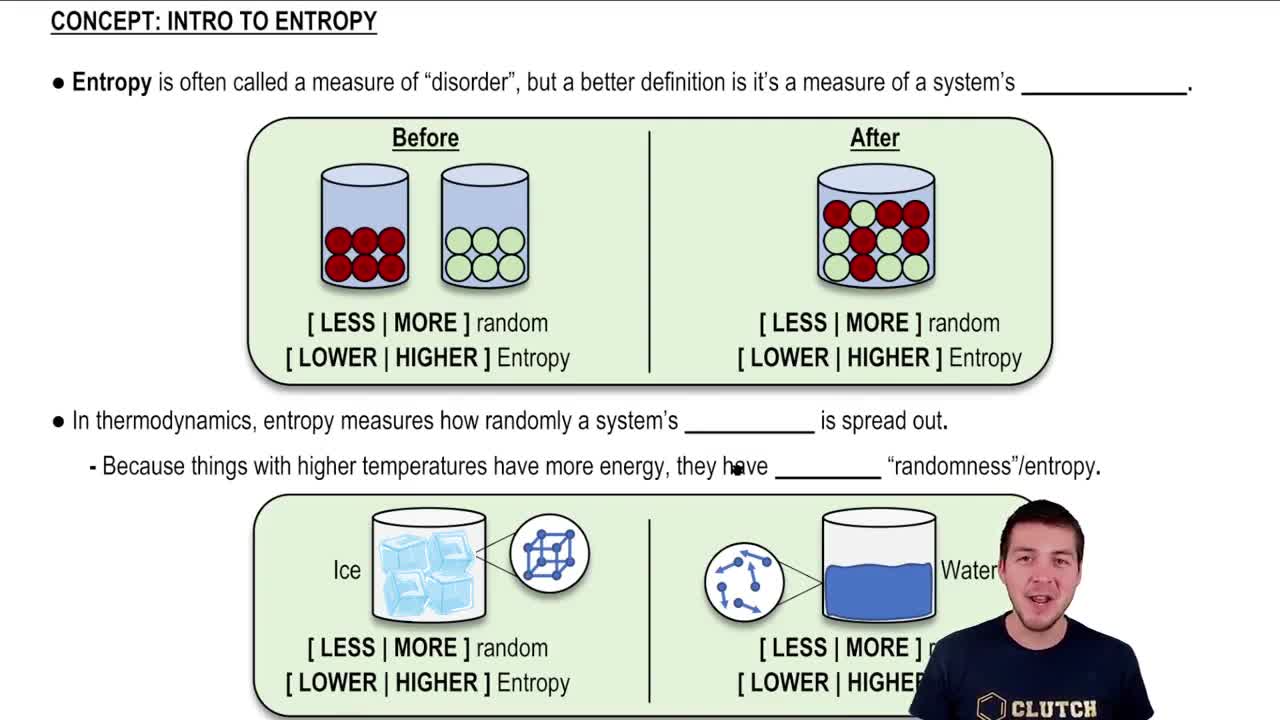
Entropy

Entropy is a measure of the disorder or randomness in a system. In thermodynamics, it quantifies the amount of energy in a physical system that is not available to do work. When a substance undergoes a phase change, such as boiling, its entropy typically increases due to the greater freedom of movement of molecules in the gas phase compared to the liquid phase.
Recommended video:
Guided course
07:50
Intro to Entropy

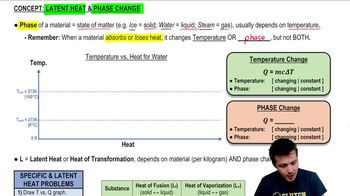
Phase Change

A phase change refers to the transition of a substance from one state of matter to another, such as from liquid to gas. During this process, energy is absorbed or released, which affects the temperature and entropy of the substance. In the case of liquid nitrogen boiling, it absorbs heat from the surroundings, leading to an increase in entropy as it transitions to the gaseous state.
Recommended video:
Guided course
10:40
Latent Heat & Phase Changes

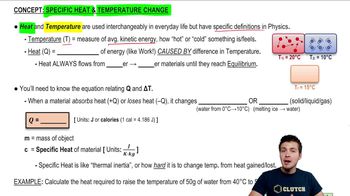
Specific Heat Capacity

Specific heat capacity is the amount of heat required to raise the temperature of a unit mass of a substance by one degree Celsius. For nitrogen gas, this value is crucial when calculating the heat absorbed as the gas warms from its boiling point to a specified temperature, such as 20℃. Understanding this concept allows for the calculation of the total heat transfer and the corresponding change in entropy during the warming process.
Recommended video:
Guided course
06:50
Specific Heat & Temperature Changes