Ch 20: The Micro/Macro Connection
Knight Calc - Physics for Scientists and Engineers 5th Edition
Knight Calc5th EditionPhysics for Scientists and EngineersISBN: 9780137344796Not the one you use?Change textbook
Chapter 20, Problem 46

Dust particles are ≈ 10 μm in diameter. They are pulverized rock, with ρ ≈ 2500 kg/m³. If you treat dust as an ideal gas, what is the rms speed of a dust particle at 20℃?

Verified step by step guidance
1
Convert the temperature from Celsius to Kelvin using the formula: \( T = T_{\text{Celsius}} + 273.15 \). For 20℃, \( T = 20 + 273.15 \).
The root-mean-square (rms) speed of a particle in an ideal gas is given by the formula: \( v_{\text{rms}} = \sqrt{\frac{3k_B T}{m}} \), where \( k_B \) is the Boltzmann constant \( (1.38 \times 10^{-23} \ \text{J/K}) \), \( T \) is the temperature in Kelvin, and \( m \) is the mass of a single particle.
Calculate the volume of a single dust particle assuming it is spherical. The formula for the volume of a sphere is \( V = \frac{4}{3} \pi r^3 \), where \( r \) is the radius. The diameter is given as \( 10 \ \mu\text{m} \), so \( r = \frac{10}{2} \ \mu\text{m} = 5 \ \mu\text{m} = 5 \times 10^{-6} \ \text{m} \). Substitute \( r \) into the formula for \( V \).
Using the density \( \rho = 2500 \ \text{kg/m}^3 \), calculate the mass of a single dust particle with the formula \( m = \rho V \). Substitute the value of \( V \) from the previous step into this formula.
Substitute the values of \( k_B \), \( T \), and \( m \) into the formula for \( v_{\text{rms}} \) to calculate the root-mean-square speed of the dust particle.

Verified video answer for a similar problem:

This video solution was recommended by our tutors as helpful for the problem above.
Video duration:
4m
Was this helpful?

Key Concepts

Here are the essential concepts you must grasp in order to answer the question correctly.

Ideal Gas Law

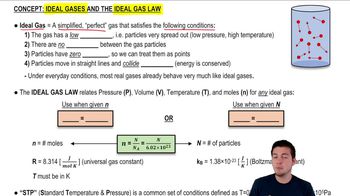
The Ideal Gas Law relates the pressure, volume, temperature, and number of moles of a gas. It is expressed as PV = nRT, where P is pressure, V is volume, n is the number of moles, R is the ideal gas constant, and T is temperature in Kelvin. This law allows us to understand the behavior of gases under various conditions, which is essential for calculating properties like speed.
Recommended video:
Guided course
07:21
Ideal Gases and the Ideal Gas Law

Root Mean Square (RMS) Speed

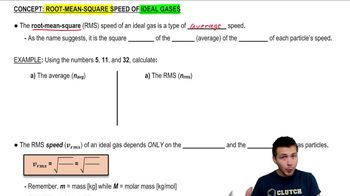
The root mean square speed is a statistical measure of the speed of particles in a gas. It is calculated using the formula v_rms = sqrt(3kT/m), where k is the Boltzmann constant, T is the absolute temperature, and m is the mass of a particle. This concept is crucial for determining the average speed of particles in an ideal gas, which helps in understanding their kinetic energy and behavior.
Recommended video:
Guided course
05:21
Root-Mean-Square Speed of Ideal Gases

Kinetic Theory of Gases

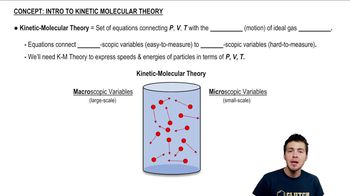
The Kinetic Theory of Gases explains the macroscopic properties of gases in terms of the motion of their molecules. It posits that gas particles are in constant random motion and that their collisions with each other and with the walls of their container result in pressure and temperature. This theory underpins the derivation of the RMS speed and connects microscopic particle behavior to macroscopic gas properties.
Recommended video:
Guided course
01:50
Introduction to Kinetic-Molecular Theory
Related Practice
Textbook Question

The pressure inside a tank of neon is 150 atm. The temperature is 25℃. On average, how many atomic diameters does a neon atom move between collisions?

1
views

Textbook Question

Interstellar space, far from any stars, is filled with a very low density of hydrogen atoms (H, not H₂). The number density is about 1 atom/cm³ and the temperature is about 3 K. Estimate the pressure in interstellar space. Give your answer in Pa and in atm.

1
views
Textbook Question

What is the entropy change of the nitrogen if 250 mL of liquid nitrogen boils away and then warms to 20℃ at constant pressure? The density of liquid nitrogen is 810 kg/m3.

1
views
Textbook Question

Interstellar space, far from any stars, is filled with a very low density of hydrogen atoms (H, not H₂). The number density is about 1 atom/cm³ and the temperature is about 3 K. What is the edge length L of an L ✕ L ✕ L cube of gas with 1.0 J of thermal energy?

1
views
Textbook Question

A mad engineer builds a cube, 2.5 m on a side, in which 6.2-cm-diameter rubber balls are constantly sent flying in random directions by vibrating walls. He will award a prize to anyone who can figure out how many balls are in the cube without entering it or taking out any of the balls. You decide to shoot 6.2-cm-diameter plastic balls into the cube, through a small hole, to see how far they get before colliding with a rubber ball. After many shots, you find they travel an average distance of 1.8 m. How many rubber balls do you think are in the cube?

1
views
Textbook Question

2.0 mol of helium at 280℃ undergo an isobaric process in which the helium entropy increases by 35 J/K. What is the final temperature of the gas?

1
views