
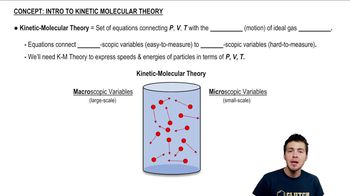
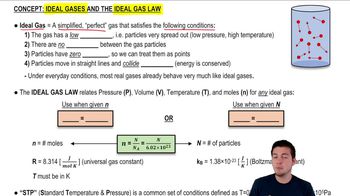
Interstellar space, far from any stars, is filled with a very low density of hydrogen atoms (H, not H₂). The number density is about 1 atom/cm³ and the temperature is about 3 K. Estimate the pressure in interstellar space. Give your answer in Pa and in atm.
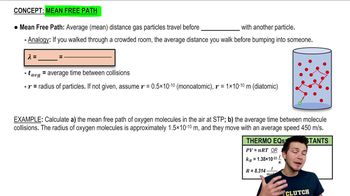
The pressure inside a tank of neon is 150 atm. The temperature is 25℃. On average, how many atomic diameters does a neon atom move between collisions?
Verified step by step guidance
Verified video answer for a similar problem:
Key Concepts
Kinetic Molecular Theory
Mean Free Path
Ideal Gas Law
What is the entropy change of the nitrogen if 250 mL of liquid nitrogen boils away and then warms to 20℃ at constant pressure? The density of liquid nitrogen is 810 kg/m3.
A 75 g ice cube at 0℃ is placed on a very large table at 20℃. You can assume that the temperature of the table does not change. As the ice cube melts and then comes to thermal equilibrium, what are the entropy changes of (a) the water, (b) the table, and (c) the universe?
Dust particles are ≈ 10 μm in diameter. They are pulverized rock, with ρ ≈ 2500 kg/m³. If you treat dust as an ideal gas, what is the rms speed of a dust particle at 20℃?
A mad engineer builds a cube, 2.5 m on a side, in which 6.2-cm-diameter rubber balls are constantly sent flying in random directions by vibrating walls. He will award a prize to anyone who can figure out how many balls are in the cube without entering it or taking out any of the balls. You decide to shoot 6.2-cm-diameter plastic balls into the cube, through a small hole, to see how far they get before colliding with a rubber ball. After many shots, you find they travel an average distance of 1.8 m. How many rubber balls do you think are in the cube?
2.0 mol of helium at 280℃ undergo an isobaric process in which the helium entropy increases by 35 J/K. What is the final temperature of the gas?
