Ch 19: Work, Heat, and the First Law of Thermodynamics
Knight Calc - Physics for Scientists and Engineers 5th Edition
Knight Calc5th EditionPhysics for Scientists and EngineersISBN: 9780137344796Not the one you use?Change textbook
Chapter 19, Problem 34

The ends of a 20-cm-long, 2.0-cm-diameter rod are maintained at 0°C and 100°C by immersion in an ice-water bath and boiling water. Heat is conducted through the rod at 4.5×10⁴ J per hour. Of what material is the rod made?

Verified step by step guidance
1
Step 1: Identify the formula for heat conduction. The rate of heat transfer through a rod is given by Fourier's law: Q/t = kA(ΔT/L), where Q/t is the heat transfer rate, k is the thermal conductivity of the material, A is the cross-sectional area, ΔT is the temperature difference, and L is the length of the rod.
Step 2: Convert the given dimensions into SI units. The length of the rod is 20 cm, which is 0.2 \, m. The diameter is 2.0 cm, which is 0.02 \, m. The radius is half the diameter, r = 0.01 \, m. The cross-sectional area is calculated using the formula for the area of a circle: A = \, \(\text{π}\)r^2.
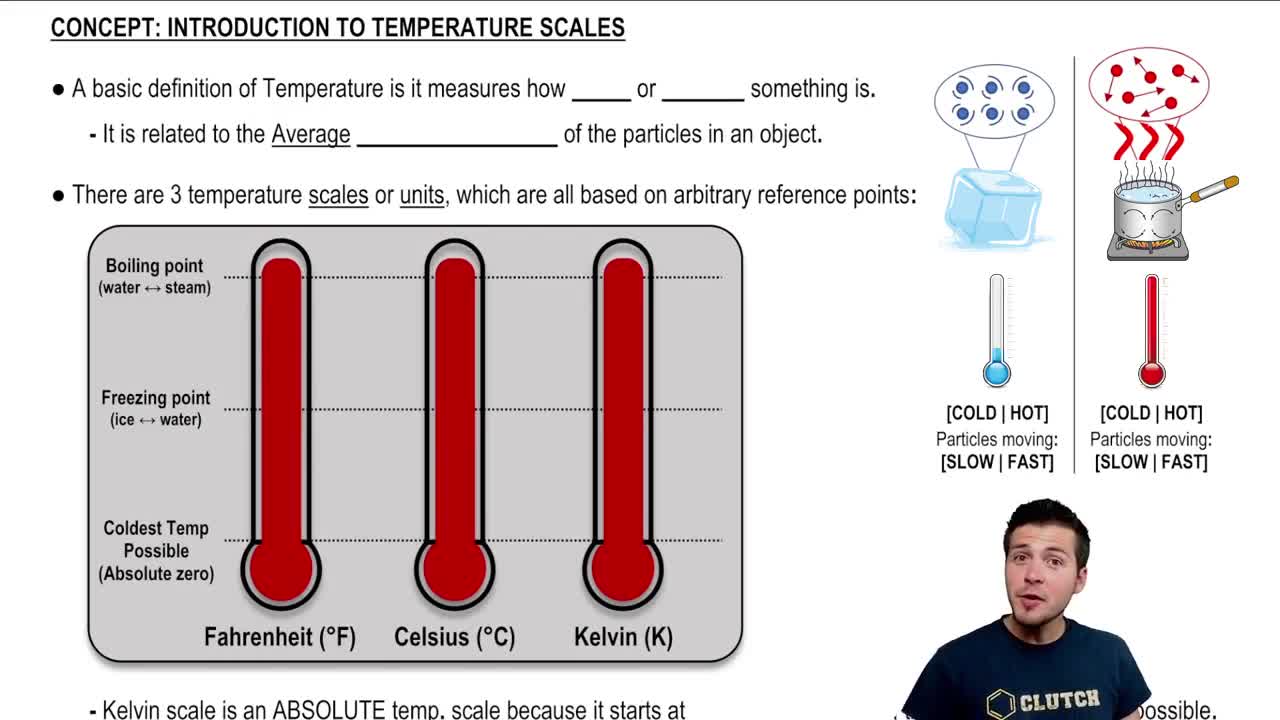
Step 3: Substitute the known values into the formula. The heat transfer rate is given as Q/t = 4.5 \, × \, 10^4 \, J/hr. Convert this to watts (joules per second) by dividing by 3600 seconds per hour: Q/t = 4.5 \, × \, 10^4 / 3600 \, W. The temperature difference is ΔT = 100 \, °C - 0 \, °C = 100 \, °C, which is equivalent to 100 K.
Step 4: Rearrange the formula to solve for the thermal conductivity k. Using k = (Q/t) \, × \, (L / (A \, × \, ΔT)), substitute the values for Q/t, L, A, and ΔT.
Step 5: Compare the calculated thermal conductivity k to known values for materials such as copper, aluminum, or steel to identify the material of the rod.

Verified video answer for a similar problem:

This video solution was recommended by our tutors as helpful for the problem above.
Video duration:
5m
Was this helpful?

Key Concepts

Here are the essential concepts you must grasp in order to answer the question correctly.

Heat Conduction

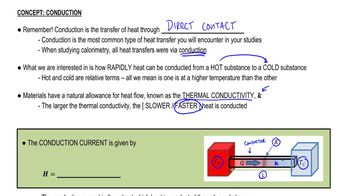
Heat conduction is the process by which thermal energy is transferred through a material without any movement of the material itself. It occurs due to the interaction of particles within the material, where faster-moving particles transfer energy to slower-moving ones. The rate of heat conduction is described by Fourier's law, which states that the heat transfer rate is proportional to the temperature gradient and the area through which heat is conducted.
Recommended video:

Thermal Conductivity

Thermal conductivity is a material property that quantifies how well a material conducts heat. It is defined as the amount of heat that passes through a unit area of the material per unit time for a given temperature difference. Different materials have different thermal conductivities, which can be used to identify the material of the rod in the question by comparing the calculated conductivity with known values for various substances.
Recommended video:

Temperature Gradient

The temperature gradient is the rate of temperature change in a given direction within a material. It is calculated as the difference in temperature between two points divided by the distance between them. In the context of heat conduction, a larger temperature gradient results in a higher rate of heat transfer, as heat flows from the hotter region to the cooler region until thermal equilibrium is reached.
Recommended video:
Guided course
04:54
Introduction To Temperature Scales