Ch 19: Work, Heat, and the First Law of Thermodynamics
Knight Calc - Physics for Scientists and Engineers 5th Edition
Knight Calc5th EditionPhysics for Scientists and EngineersISBN: 9780137344796Not the one you use?Change textbook
Chapter 19, Problem 39

A 5.0 g ice cube at −20°C is in a rigid, sealed container from which all the air has been evacuated. How much heat is required to change this ice cube into steam at 200°C? Steam has cV = 1500 J/kg K and cP = 1960 J/kg K.

Verified step by step guidance
1
Step 1: Calculate the heat required to raise the temperature of the ice cube from −20°C to 0°C using the formula for heat transfer: Q=mcΔT, where m is the mass of the ice cube, c is the specific heat capacity of ice (approximately 2100 J/kg·K), and ΔT is the temperature change.
Step 2: Calculate the heat required to melt the ice at 0°C into water using the formula: Q=mL, where L is the latent heat of fusion for water (approximately 334,000 J/kg).
Step 3: Calculate the heat required to raise the temperature of the water from 0°C to 100°C using the formula: Q=mcΔT, where c is the specific heat capacity of water (approximately 4186 J/kg·K).
Step 4: Calculate the heat required to convert the water at 100°C into steam using the formula: Q=mL, where L is the latent heat of vaporization for water (approximately 2,260,000 J/kg).
Step 5: Calculate the heat required to raise the temperature of the steam from 100°C to 200°C using the formula: Q=mcΔT, where c is the specific heat capacity of steam (given as 1500 J/kg·K for constant volume or 1960 J/kg·K for constant pressure).

Verified video answer for a similar problem:

This video solution was recommended by our tutors as helpful for the problem above.
Video duration:
7m
Was this helpful?

Key Concepts

Here are the essential concepts you must grasp in order to answer the question correctly.

Phase Changes

Phase changes refer to the transitions between solid, liquid, and gas states of matter. In this problem, the ice cube undergoes multiple phase changes: melting into water, boiling into steam, and then heating the steam. Each phase change requires a specific amount of heat, known as latent heat, which is essential for calculating the total heat required.
Recommended video:
Guided course
10:40
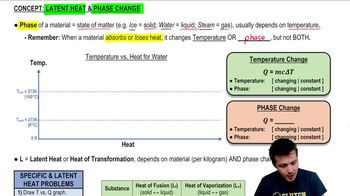
Latent Heat & Phase Changes

Specific Heat Capacity

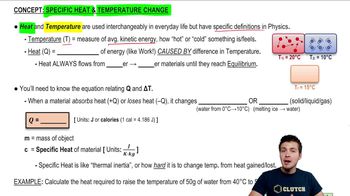
Specific heat capacity is the amount of heat required to raise the temperature of a unit mass of a substance by one degree Celsius. In this scenario, the specific heat capacities of ice, water, and steam are crucial for determining how much heat is needed to change the temperature of each phase before and after the phase changes occur.
Recommended video:
Guided course
06:50
Specific Heat & Temperature Changes

Latent Heat

Latent heat is the heat energy absorbed or released during a phase change without a change in temperature. For this problem, the latent heat of fusion (for melting ice) and the latent heat of vaporization (for converting water to steam) are key to calculating the total heat required to transform the ice cube into steam at the specified temperature.
Recommended video:
Guided course
10:40
Latent Heat & Phase Changes
Related Practice
Textbook Question

512 g of an unknown metal at a temperature of 15°C is dropped into a 100 g aluminum container holding 325 g of water at 98°C. A short time later, the container of water and metal stabilizes at a new temperature of 78°C. Identify the metal.

1
views
Textbook Question

The burner on an electric stove has a power output of 2.0 kW. A 750 g stainless steel teakettle is filled with 20°C water and placed on the already hot burner. If it takes 3.0 min for the water to reach a boil, what volume of water, in cm3, was in the kettle? Stainless steel is mostly iron, so you can assume its specific heat is that of iron.

1
views
Textbook Question

You are boiling pasta and absentmindedly grab a copper stirring spoon rather than your wooden spoon. The copper spoon has a 20 mm ×1.5 mm rectangular cross section, and the distance from the boiling water to your 35°C hand is 18 cm. How long does it take the spoon to transfer 25 J of energy to your hand?

1
views
Textbook Question

When air is inhaled, it quickly becomes saturated with water vapor as it passes through the moist airways. Consequently, an adult human exhales about 25 mg of evaporated water with each breath. Evaporation—a phase change—requires heat, and the heat energy is removed from your body. Evaporation is much like boiling, only water's heat of vaporization at 35°C is a somewhat larger 24×105 J/kg because at lower temperatures more energy is required to break the molecular bonds. At 12 breaths/min, on a dry day when the inhaled air has almost no water content, what is the body's rate of energy loss (in J/s) due to exhaled water? (For comparison, the energy loss from radiation, usually the largest loss on a cool day, is about 100 J/s.)

2
views
1
rank
Textbook Question

A 5.0-m-diameter garden pond is 30 cm deep. Solar energy is incident on the pond at an average rate of 400 W/m2. If the water absorbs all the solar energy and does not exchange energy with its surroundings, how many hours will it take to warm from 15°C to 25°C?

1
views
Textbook Question

The ends of a 20-cm-long, 2.0-cm-diameter rod are maintained at 0°C and 100°C by immersion in an ice-water bath and boiling water. Heat is conducted through the rod at 4.5×10⁴ J per hour. Of what material is the rod made?

2
views