
Ch 18: A Macroscopic Description of Matter
Knight Calc - Physics for Scientists and Engineers 5th Edition
Knight Calc5th EditionPhysics for Scientists and EngineersISBN: 9780137344796Not the one you use?Change textbook
Chapter 18, Problem 55

The interior of a Boeing 737-800 can be modeled as a 32-m-long, 3.7-m-diameter cylinder. The air inside, at cruising altitude, is 20°C at a pressure of 82 kPa. What volume of outside air, at −40°C and a pressure of 23 kPa, must be drawn in, heated, and compressed to fill the plane?

Verified step by step guidance
1
Step 1: Calculate the volume of the interior of the Boeing 737-800 using the formula for the volume of a cylinder: \( V = \pi r^2 h \), where \( r \) is the radius and \( h \) is the height (or length). The radius can be found by dividing the diameter by 2.
Step 2: Use the Ideal Gas Law \( PV = nRT \) to determine the number of moles of air \( n \) inside the plane at cruising altitude. Rearrange the equation to \( n = \frac{PV}{RT} \), where \( P \) is the pressure, \( V \) is the volume, \( R \) is the universal gas constant (8.314 J/(mol·K)), and \( T \) is the temperature in Kelvin.
Step 3: Convert the temperature inside the plane from Celsius to Kelvin using \( T(K) = T(°C) + 273.15 \). Similarly, convert the outside air temperature from Celsius to Kelvin.
Step 4: Use the Ideal Gas Law again to calculate the volume of outside air needed to provide the same number of moles \( n \) as calculated in Step 2. Rearrange the equation to \( V = \frac{nRT}{P} \), where \( P \) is the pressure of the outside air, \( T \) is the temperature of the outside air, and \( n \) is the number of moles determined earlier.
Step 5: Substitute the values for \( n \), \( R \), \( T \), and \( P \) into the equation from Step 4 to find the volume of outside air required. Ensure all units are consistent (e.g., pressure in Pascals, volume in cubic meters, temperature in Kelvin).

Verified video answer for a similar problem:

This video solution was recommended by our tutors as helpful for the problem above.
Video duration:
7m
Was this helpful?

Key Concepts

Here are the essential concepts you must grasp in order to answer the question correctly.

Ideal Gas Law

The Ideal Gas Law relates the pressure, volume, temperature, and number of moles of a gas through the equation PV = nRT. This law is essential for understanding how gases behave under different conditions, allowing us to calculate the volume of air needed based on changes in temperature and pressure.
Recommended video:
Guided course
07:21
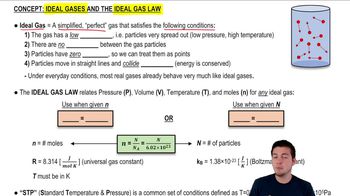
Ideal Gases and the Ideal Gas Law

Volume of a Cylinder

The volume of a cylinder can be calculated using the formula V = πr²h, where r is the radius and h is the height (or length). In this context, it helps determine the volume of the Boeing 737-800's interior, which is crucial for understanding how much air needs to be processed.
Recommended video:
Guided course
05:21
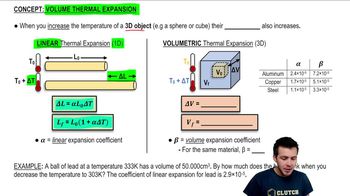
Volume Thermal Expansion

Thermodynamics

Thermodynamics is the study of energy transfer and the laws governing heat and work. In this scenario, it is important to consider how the outside air will be heated and compressed, as these processes will affect the air's volume and pressure, impacting the calculations needed to fill the plane.
Recommended video:
Guided course
08:04
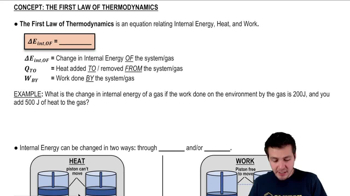
The First Law of Thermodynamics