
Ch 18: A Macroscopic Description of Matter
Knight Calc - Physics for Scientists and Engineers 5th Edition
Knight Calc5th EditionPhysics for Scientists and EngineersISBN: 9780137344796Not the one you use?Change textbook
Chapter 18, Problem 52

On a cool morning, when the temperature is 15°C, you measure the pressure in your car tires to be 30 psi. After driving 20 mi on the freeway, the temperature of your tires is 45°C . What pressure will your tire gauge now show?

Verified step by step guidance
1
Step 1: Recognize that this problem involves the relationship between pressure, temperature, and volume for a gas. Since the volume of the tire and the amount of gas inside remain constant, we can use the ideal gas law in the form of the combined gas law: \( \frac{P_1}{T_1} = \frac{P_2}{T_2} \), where \(P\) is pressure and \(T\) is temperature in Kelvin.
Step 2: Convert the given temperatures from Celsius to Kelvin using the formula \( T(K) = T(°C) + 273.15 \). For the initial temperature, \( T_1 = 15 + 273.15 \). For the final temperature, \( T_2 = 45 + 273.15 \).
Step 3: Rearrange the combined gas law to solve for the final pressure \( P_2 \): \( P_2 = P_1 \cdot \frac{T_2}{T_1} \). Here, \( P_1 \) is the initial pressure (30 psi), \( T_1 \) is the initial temperature in Kelvin, and \( T_2 \) is the final temperature in Kelvin.
Step 4: Substitute the known values into the equation. Use \( P_1 = 30 \) psi, \( T_1 = 15 + 273.15 \), and \( T_2 = 45 + 273.15 \). Perform the division \( \frac{T_2}{T_1} \) and multiply by \( P_1 \) to find \( P_2 \).
Step 5: The result \( P_2 \) represents the pressure in the tires after driving. Note that this is the absolute pressure. If the tire gauge measures gauge pressure, you may need to subtract atmospheric pressure (approximately 14.7 psi) to find the gauge pressure.

Verified video answer for a similar problem:

This video solution was recommended by our tutors as helpful for the problem above.
Video duration:
5m
Was this helpful?

Key Concepts

Here are the essential concepts you must grasp in order to answer the question correctly.

Ideal Gas Law

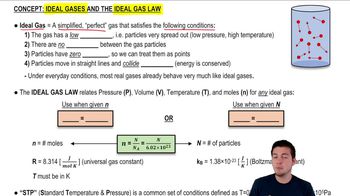
The Ideal Gas Law relates the pressure, volume, and temperature of an ideal gas through the equation PV = nRT. In this context, it helps us understand how the pressure of the air in the tires changes with temperature, assuming the volume remains constant. As temperature increases, the kinetic energy of gas molecules increases, leading to higher pressure.
Recommended video:
Guided course
07:21
Ideal Gases and the Ideal Gas Law

Charles's Law

Charles's Law states that the volume of a gas is directly proportional to its temperature when pressure is held constant. Although the volume of the tire does not change significantly, this law illustrates the relationship between temperature and pressure, indicating that as the temperature of the gas increases, so does the pressure, assuming the volume remains constant.
Recommended video:

Pressure-Temperature Relationship

The pressure-temperature relationship in gases indicates that an increase in temperature results in an increase in pressure, provided the volume is constant. This principle is crucial for understanding how the tire pressure will change after driving, as the temperature of the air inside the tires rises from 15°C to 45°C, leading to a measurable increase in pressure.
Recommended video:
Guided course
08:10
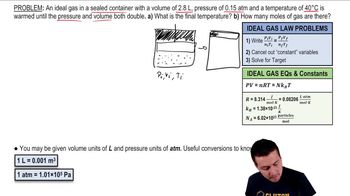
Doubling Pressure & Temperature
Related Practice
Textbook Question

The 3.0-m-long pipe in FIGURE P18.49 is closed at the top end. It is slowly pushed straight down into the water until the top end of the pipe is level with the water's surface. What is the length L of the trapped volume of air?

2
views
Textbook Question

A 10-cm-diameter, 40-cm-tall gas cylinder, sealed at the top by a frictionless 50 kg piston, is surrounded by a bath of 20°C water. Then 50 kg of sand is slowly poured onto the top of the piston, where it stays. Afterward, what is the height of the piston?

1
views
Textbook Question

A diving bell is a 3.0-m-tall cylinder closed at the upper end but open at the lower end. The temperature of the air in the bell is 20°C. The bell is lowered into the ocean until its lower end is 100 m deep. The temperature at that depth is 10°C. How high does the water rise in the bell after enough time has passed for the air inside to reach thermal equilibrium?

1
views
Textbook Question

An electric generating plant boils water to produce high-pressure steam. The steam spins a turbine that is connected to the generator. How many liters of water must be boiled to fill a 5.0 m3 boiler with 50 atm of steam at 400°C?

1
views
Textbook Question

The 50 kg circular piston shown in FIGURE P18.57 floats on 0.12 mol of compressed air. What is the piston height h if the temperature is 30°C?

1
views
Textbook Question

The interior of a Boeing 737-800 can be modeled as a 32-m-long, 3.7-m-diameter cylinder. The air inside, at cruising altitude, is 20°C at a pressure of 82 kPa. What volume of outside air, at −40°C and a pressure of 23 kPa, must be drawn in, heated, and compressed to fill the plane?

1
views