
Ch 18: A Macroscopic Description of Matter
Knight Calc - Physics for Scientists and Engineers 5th Edition
Knight Calc5th EditionPhysics for Scientists and EngineersISBN: 9780137344796Not the one you use?Change textbook
Chapter 18, Problem 57b

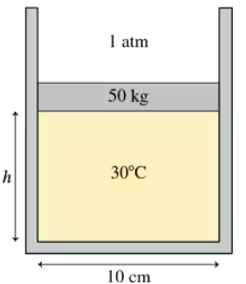
The 50 kg circular piston shown in FIGURE P18.57 floats on 0.12 mol of compressed air. How far does the piston move if the temperature is increased by 100°C?

Verified step by step guidance
1
Step 1: Identify the relationship between pressure, volume, and temperature using the Ideal Gas Law: \( PV = nRT \), where \( P \) is pressure, \( V \) is volume, \( n \) is the number of moles, \( R \) is the gas constant, and \( T \) is temperature in Kelvin.
Step 2: Convert the temperature change from Celsius to Kelvin. Since \( T_{Kelvin} = T_{Celsius} + 273.15 \), the temperature increase of 100°C corresponds to an increase of 100 K.
Step 3: Recognize that the piston floats, meaning the pressure exerted by the gas equals the pressure due to the weight of the piston. The pressure can be expressed as \( P = \frac{mg}{A} \), where \( m \) is the mass of the piston, \( g \) is the acceleration due to gravity, and \( A \) is the cross-sectional area of the piston.
Step 4: Relate the change in volume to the change in temperature using the Ideal Gas Law. Since \( P \) remains constant, \( \frac{V_1}{T_1} = \frac{V_2}{T_2} \). Solve for \( \Delta V = V_2 - V_1 \), where \( V_1 \) is the initial volume and \( V_2 \) is the final volume.
Step 5: Calculate the displacement of the piston. The change in volume \( \Delta V \) corresponds to the change in height \( \Delta h \) of the piston, given by \( \Delta V = A \Delta h \). Solve for \( \Delta h = \frac{\Delta V}{A} \).

Verified video answer for a similar problem:

This video solution was recommended by our tutors as helpful for the problem above.
Video duration:
12m
Was this helpful?

Key Concepts

Here are the essential concepts you must grasp in order to answer the question correctly.

Ideal Gas Law

The Ideal Gas Law relates the pressure, volume, temperature, and number of moles of a gas through the equation PV = nRT. This law is essential for understanding how changes in temperature affect the behavior of gases, particularly in a confined space like the piston. It allows us to calculate the change in volume or pressure when the temperature is altered.
Recommended video:
Guided course
07:21
Ideal Gases and the Ideal Gas Law

Thermal Expansion

Thermal expansion refers to the increase in volume of a substance as its temperature rises. In the context of gases, as temperature increases, the kinetic energy of gas molecules increases, causing them to occupy more space. This principle is crucial for determining how much the piston will move when the temperature of the compressed air is raised.
Recommended video:
Guided course
05:21
Volume Thermal Expansion

Pressure-Volume Relationship

The pressure-volume relationship, often described by Boyle's Law, states that for a given amount of gas at constant temperature, the pressure of the gas is inversely proportional to its volume. Understanding this relationship is vital for predicting how the piston will respond to changes in temperature and volume, as the gas expands and exerts pressure on the piston.
Recommended video:
Guided course
17:04
Pressure and Atmospheric Pressure
Related Practice
Textbook Question

A 10-cm-diameter, 40-cm-tall gas cylinder, sealed at the top by a frictionless 50 kg piston, is surrounded by a bath of 20°C water. Then 50 kg of sand is slowly poured onto the top of the piston, where it stays. Afterward, what is the height of the piston?

1
views
Textbook Question

A diver 50 m deep in 10°C fresh water exhales a 1.0-cm-diameter bubble. What is the bubble's diameter just as it reaches the surface of the lake, where the water temperature is 20°C?

1
views
Textbook Question

10 g of dry ice (solid CO₂) is placed in a 10,000 cm3 container, then all the air is quickly pumped out and the container sealed. The container is warmed to 0°C, a temperature at which CO₂ is a gas. What is the gas pressure? Give your answer in atm. The gas then undergoes an isothermal compression until the pressure is 3.0 atm, immediately followed by an isobaric compression until the volume is 1000 cm3.

1
views
Textbook Question

In Problems 67,68,69,67, 68, 69, and 7070 you are given the equation(s) used to solve a problem. For each of these, you are to draw a pV diagram.

(T2+273) K=200 kPa500 kPa×1×(400+273) K(T_2 + 273) \(\text{ K}\) = \(\frac{200 \text{ kPa}\)}{500 \(\text{ kPa}\)} \(\times\) 1 \(\times\) (400 + 273) \(\text{ K}\)

1
views
Textbook Question

The 50 kg circular piston shown in FIGURE P18.57 floats on 0.12 mol of compressed air. What is the piston height h if the temperature is 30°C?

1
views
Textbook Question

The interior of a Boeing 737-800 can be modeled as a 32-m-long, 3.7-m-diameter cylinder. The air inside, at cruising altitude, is 20°C at a pressure of 82 kPa. What volume of outside air, at −40°C and a pressure of 23 kPa, must be drawn in, heated, and compressed to fill the plane?

1
views