Ch 18: A Macroscopic Description of Matter
Knight Calc - Physics for Scientists and Engineers 5th Edition
Knight Calc5th EditionPhysics for Scientists and EngineersISBN: 9780137344796Not the one you use?Change textbook
Chapter 18, Problem 14

At room temperature (20°C), a 5.0-cm-long brass rod is 20 μm too long to fit into a slot. To what temperature should you cool the rod so that it just barely fits?

Verified step by step guidance
1
Step 1: Understand the problem. The brass rod is currently too long to fit into the slot by 20 μm. To solve this, we need to calculate the temperature at which the rod contracts enough to fit. This involves the concept of thermal expansion, where the length of a material changes with temperature.
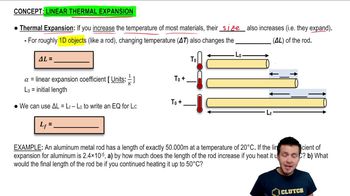
Step 2: Write the formula for linear thermal expansion: ΔL = L₀αΔT, where ΔL is the change in length, L₀ is the initial length of the rod, α is the coefficient of linear expansion for brass, and ΔT is the change in temperature.
Step 3: Rearrange the formula to solve for ΔT: ΔT = ΔL / (L₀α). Here, ΔL is the amount the rod needs to contract (20 μm = 20 × 10⁻⁶ m), L₀ is the initial length of the rod (5.0 cm = 0.050 m), and α is the coefficient of linear expansion for brass (approximately 19 × 10⁻⁶ /°C).
Step 4: Substitute the known values into the formula: ΔT = (20 × 10⁻⁶) / (0.050 × 19 × 10⁻⁶). This will give the temperature change required for the rod to contract by 20 μm.
Step 5: Determine the final temperature. Since the initial temperature is 20°C, subtract the calculated ΔT from 20°C to find the temperature to which the rod must be cooled.

Verified video answer for a similar problem:

This video solution was recommended by our tutors as helpful for the problem above.
Video duration:
3m
Was this helpful?

Key Concepts

Here are the essential concepts you must grasp in order to answer the question correctly.

Thermal Expansion

Thermal expansion refers to the tendency of materials to change in size or volume in response to changes in temperature. For solids, this is typically linear expansion, where the length of an object increases with temperature. The relationship is often described by the formula ΔL = αL₀ΔT, where ΔL is the change in length, α is the coefficient of linear expansion, L₀ is the original length, and ΔT is the change in temperature.
Recommended video:
Guided course
05:21
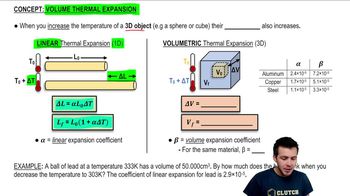
Volume Thermal Expansion

Coefficient of Linear Expansion

The coefficient of linear expansion (α) is a material-specific constant that quantifies how much a material expands per degree of temperature change. For brass, this value is approximately 19 x 10⁻⁶ /°C. Understanding this coefficient is crucial for calculating how much a given length of brass will contract or expand when subjected to temperature changes.
Recommended video:
Guided course
07:31
Linear Thermal Expansion

Temperature Change Calculation

To determine the necessary temperature change to achieve a specific length adjustment, one can rearrange the thermal expansion formula. By knowing the initial length, the desired length, and the coefficient of linear expansion, one can solve for the change in temperature (ΔT). This calculation is essential for finding the temperature at which the brass rod will fit into the slot.
Recommended video:
Guided course
06:50
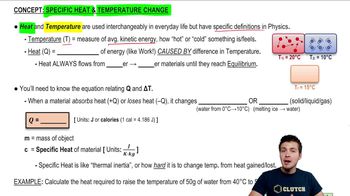
Specific Heat & Temperature Changes
Related Practice
Textbook Question

A cylinder contains nitrogen gas. A piston compresses the gas to half its initial volume. Afterward, has the mass density of the gas changed? If so, by what factor? If not, why not?

1
views

Textbook Question

A surveyor has a steel measuring tape that is calibrated to be 100.000 m long (i.e., accurate to ±1 mm) at 20°C. If she measures the distance between two stakes to be 65.175 m on a 3°C day, does she need to add or subtract a correction factor to get the true distance? How large, in mm, is the correction factor?

1
views
Textbook Question

A demented scientist creates a new temperature scale, the 'Z scale.' He decides to call the boiling point of nitrogen 0°Z and the melting point of iron 1000°Z. Convert 500°Z to degrees Celsius and to kelvins.

13
views
1
rank
Textbook Question

An element in its solid phase has mass density 1750 kg/m3 and number density 4.39×1028 atoms/m3. What is the element's atomic mass number?

3
views
Textbook Question

The lowest and highest natural temperatures ever recorded on earth are −129°F in Antarctica and 134°F in Death Valley. What are these temperatures in °C and in K?

17
views
Textbook Question
Common outdoor thermometers are filled with red-colored ethyl alcohol. One thermometer has a 0.40-mm-diameter capillary tube attached to a 9.0-mm-diameter spherical bulb. On a 0°C morning, the column of alcohol stands 30 mm above the bulb. What is the temperature in °C when the column of alcohol stands 130 mm above the bulb? The expansion of the glass is much less than that of the alcohol and can be ignored.
3
views