Ch 18: A Macroscopic Description of Matter
Knight Calc - Physics for Scientists and Engineers 5th Edition
Knight Calc5th EditionPhysics for Scientists and EngineersISBN: 9780137344796Not the one you use?Change textbook
Chapter 18, Problem 17

A surveyor has a steel measuring tape that is calibrated to be 100.000 m long (i.e., accurate to ±1 mm) at 20°C. If she measures the distance between two stakes to be 65.175 m on a 3°C day, does she need to add or subtract a correction factor to get the true distance? How large, in mm, is the correction factor?

Verified step by step guidance
1
Step 1: Understand the problem. The steel measuring tape expands or contracts with temperature changes due to thermal expansion. The tape is calibrated at 20°C, but the measurement is taken at 3°C. We need to determine the correction factor to account for this temperature difference.
Step 2: Recall the formula for linear thermal expansion: ΔL=LαΔT, where ΔL is the change in length, L is the original length, α is the coefficient of linear expansion for steel, and ΔT is the temperature change.
Step 3: Calculate the temperature change: ΔT=203=17°C. The tape is colder than its calibration temperature, so it contracts.
Step 4: Substitute the values into the formula. Use the coefficient of linear expansion for steel, which is approximately 11×106/°C. The original length of the tape is 65.175 m. The formula becomes: ΔL=65.17511×10617.
Step 5: Interpret the result. The value of ΔL will be negative, indicating contraction. Convert the result to millimeters by multiplying by 1000 (since 1 m = 1000 mm). The correction factor should be subtracted from the measured distance to get the true distance.

Verified video answer for a similar problem:

This video solution was recommended by our tutors as helpful for the problem above.
Video duration:
4m
Was this helpful?

Key Concepts

Here are the essential concepts you must grasp in order to answer the question correctly.

Thermal Expansion

Thermal expansion refers to the tendency of materials to change in size or volume in response to changes in temperature. For metals like steel, this means that as temperature decreases, the material contracts, leading to a shorter length. Understanding this concept is crucial for determining how much the measuring tape's length will change when the temperature drops from 20°C to 3°C.
Recommended video:
Guided course
05:21
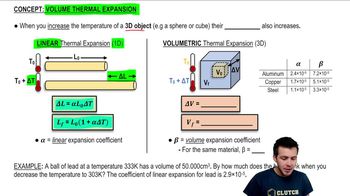
Volume Thermal Expansion

Coefficient of Linear Expansion

The coefficient of linear expansion is a material-specific constant that quantifies how much a unit length of a material expands or contracts per degree change in temperature. For steel, this coefficient is typically around 11 x 10^-6 /°C. This value is essential for calculating the correction factor needed to adjust the measured length of the tape based on the temperature difference.
Recommended video:
Guided course
07:31
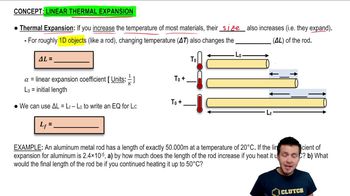
Linear Thermal Expansion

Correction Factor

A correction factor is an adjustment made to account for systematic errors in measurements due to external conditions, such as temperature. In this scenario, the correction factor will be calculated using the change in temperature and the coefficient of linear expansion to determine how much the tape's length has changed, ensuring that the final measurement reflects the true distance between the stakes.
Recommended video:
Guided course
05:00
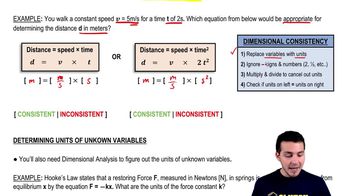
Dimensional Analysis