
String 1 in FIGURE P16.47 has linear density 2.0 g/m and string 2 has linear density. A student sends pulses in both directions by quickly pulling up on the knot, then releasing it. What should the string lengths L₁ and L₂ be if the pulses are to reach the ends of the strings simultaneously?
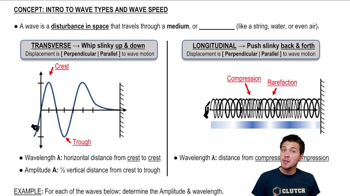
Earthquakes are essentially sound waves—called seismic waves—traveling through the earth. Because the earth is solid, it can support both longitudinal and transverse seismic waves. The speed of longitudinal waves, called P waves, is 8000 m/s. Transverse waves, called S waves, travel at a slower 4500 m/s. A seismograph records the two waves from a distant earthquake. If the S wave arrives 2.0 min after the P wave, how far away was the earthquake? You can assume that the waves travel in straight lines, although actual seismic waves follow more complex routes.
Verified step by step guidance
Verified video answer for a similar problem:
Key Concepts
Seismic Waves
Wave Speed
Time Difference and Distance Calculation
One cue your hearing system uses to localize a sound (i.e., to tell where a sound is coming from) is the slight difference in the arrival times of the sound at your ears. Your ears are spaced approximately 20 cm apart. Consider a sound source 5.0 m from the center of your head along a line 45° to your right. What is the difference in arrival times? Give your answer in microseconds. Hint: You are looking for the difference between two numbers that are nearly the same. What does this near equality imply about the necessary precision during intermediate stages of the calculation?
FIGURE P16.45 is a snapshot graph at t = 0 s of a 5.0 Hz wave traveling to the left. Write the displacement equation for this wave.
A 20.0-cm-long, 10.0-cm-diameter cylinder with a piston at one end contains 1.34 kg of an unknown liquid. Using the piston to compress the length of the liquid by 1.00 mm increases the pressure by 41.0 atm. What is the speed of sound in the liquid?
A sound wave is described by , where is in and is in . Along which axis is the air oscillating?
A helium-neon laser beam has a wavelength in air of 633 nm. It takes 1.38 ns for the light to travel through 30 cm of an unknown liquid. What is the wavelength of the laser beam in the liquid?
