Ch 16: Traveling Waves
Knight Calc - Physics for Scientists and Engineers 5th Edition
Knight Calc5th EditionPhysics for Scientists and EngineersISBN: 9780137344796Not the one you use?Change textbook
Chapter 16, Problem 53

A 20.0-cm-long, 10.0-cm-diameter cylinder with a piston at one end contains 1.34 kg of an unknown liquid. Using the piston to compress the length of the liquid by 1.00 mm increases the pressure by 41.0 atm. What is the speed of sound in the liquid?

Verified step by step guidance
1
Determine the bulk modulus of the liquid using the relationship between pressure change and volume change. The formula is: B=ΔPΔVV, where ΔP is the pressure change, ΔV is the volume change, and V is the initial volume.
Calculate the initial volume of the cylinder using the formula for the volume of a cylinder: V=πr²h, where r is the radius (half the diameter) and h is the height (length of the cylinder).
Determine the volume change ΔV caused by the compression. Since the length of the cylinder is reduced by 1.00 mm, the new volume is slightly smaller. Use the formula: ΔV=πr²Δh, where Δh is the change in height.
Substitute the values for ΔP, ΔV, and V into the bulk modulus formula to calculate B.
Use the formula for the speed of sound in a liquid: v=Bρ, where ρ is the density of the liquid. Calculate the density using ρ=mV, where m is the mass of the liquid and V is the initial volume. Substitute the values of B and ρ into the speed of sound formula to find the result.

Verified video answer for a similar problem:

This video solution was recommended by our tutors as helpful for the problem above.
Video duration:
9m
Was this helpful?

Key Concepts

Here are the essential concepts you must grasp in order to answer the question correctly.

Pressure and Volume Relationship

In fluid mechanics, the relationship between pressure and volume is described by the principles of compressibility. When a fluid is compressed, its volume decreases, leading to an increase in pressure. This relationship is crucial for understanding how changes in volume affect the pressure exerted by the fluid, which is essential for solving problems involving fluid dynamics.
Recommended video:
Guided course
17:04
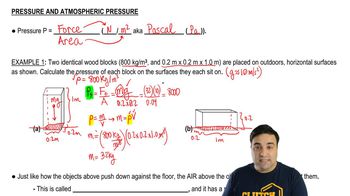
Pressure and Atmospheric Pressure

Speed of Sound in Fluids

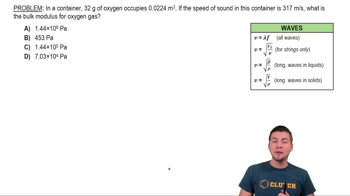
The speed of sound in a fluid is determined by the fluid's density and its bulk modulus, which measures the fluid's resistance to compression. The formula for the speed of sound (v) is given by v = √(B/ρ), where B is the bulk modulus and ρ is the density. Understanding this relationship is vital for calculating the speed of sound in the unknown liquid after determining its properties from the given data.
Recommended video:
Guided course
6:34
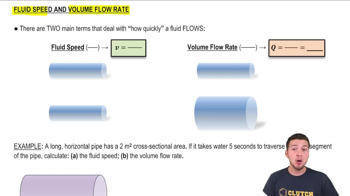
Fluid Speed & Volume Flow Rate

Bulk Modulus

The bulk modulus is a measure of a material's resistance to uniform compression. It is defined as the ratio of the change in pressure to the fractional change in volume. In the context of the problem, knowing the bulk modulus allows us to relate the change in pressure caused by the piston to the resulting change in volume, which is necessary for calculating the speed of sound in the liquid.
Recommended video:
Related Practice
Textbook Question

FIGURE P16.57 shows a snapshot graph of a wave traveling to the right along a string at 45 m/s. At this instant, what is the velocity of points 1, 2, and 3 on the string?

9
views

Textbook Question

One cue your hearing system uses to localize a sound (i.e., to tell where a sound is coming from) is the slight difference in the arrival times of the sound at your ears. Your ears are spaced approximately 20 cm apart. Consider a sound source 5.0 m from the center of your head along a line 45° to your right. What is the difference in arrival times? Give your answer in microseconds. Hint: You are looking for the difference between two numbers that are nearly the same. What does this near equality imply about the necessary precision during intermediate stages of the calculation?

4
views
Textbook Question

Earthquakes are essentially sound waves—called seismic waves—traveling through the earth. Because the earth is solid, it can support both longitudinal and transverse seismic waves. The speed of longitudinal waves, called P waves, is 8000 m/s. Transverse waves, called S waves, travel at a slower 4500 m/s. A seismograph records the two waves from a distant earthquake. If the S wave arrives 2.0 min after the P wave, how far away was the earthquake? You can assume that the waves travel in straight lines, although actual seismic waves follow more complex routes.

1
views
Textbook Question

A sound wave is described by D(y,t)=(0.0200mm)×sin[(8.96rad/m)y+(3140rad/s)t+π/4rad]D(y, t) = (0.0200 \, \(\text{mm}\)) \(\times\) \(\sin\)[(8.96 \, \(\text{rad/m}\))y + (3140 \, \(\text{rad/s}\))t + \(\pi\)/4 \, \(\text{rad}\)], where yy is in mm and tt is in ss. Along which axis is the air oscillating?

15
views
Textbook Question

A helium-neon laser beam has a wavelength in air of 633 nm. It takes 1.38 ns for the light to travel through 30 cm of an unknown liquid. What is the wavelength of the laser beam in the liquid?

1
views
Textbook Question

A wave on a string is described by D(x,t)=(2.00cm)×sin[(12.57rad/m)x(638rad/s)t]D(x,t) = (2.00 \, \(\text{cm}\)) \(\times\) \(\sin\)[(12.57 \, \(\text{rad/m}\))x - (638 \, \(\text{rad/s}\)) t], where xx is in mm and tt in ss. The linear density of the string is 5.00 g/m5.00\(\text{ g/m}\). What are The maximum speed of a point on the string?