Ch 16: Traveling Waves
Knight Calc - Physics for Scientists and Engineers 5th Edition
Knight Calc5th EditionPhysics for Scientists and EngineersISBN: 9780137344796Not the one you use?Change textbook
Chapter 16, Problem 54b

A sound wave is described by D(y,t)=(0.0200mm)×sin[(8.96rad/m)y+(3140rad/s)t+π/4rad]D(y, t) = (0.0200 \, \(\text{mm}\)) \(\times\) \(\sin\)[(8.96 \, \(\text{rad/m}\))y + (3140 \, \(\text{rad/s}\))t + \(\pi\)/4 \, \(\text{rad}\)], where yy is in mm and tt is in ss. Along which axis is the air oscillating?

Verified step by step guidance
1
The given equation for the sound wave is D(y, t) = (0.0200 mm) × sin[(8.96 rad/m)y + (3140 rad/s)t + π/4 rad]. Here, D represents the displacement of the air particles as a function of position (y) and time (t).
In a sound wave, the air particles oscillate in the direction of the wave's propagation if it is a longitudinal wave. For a transverse wave, the oscillation would be perpendicular to the direction of propagation.
The equation shows that the wave is propagating along the y-axis because the term (8.96 rad/m)y indicates that the wave's spatial variation depends on the y-coordinate.
Since sound waves in air are longitudinal waves, the air particles oscillate parallel to the direction of wave propagation. Therefore, the air particles oscillate along the y-axis.
To summarize, the air oscillates along the y-axis because the wave is propagating in that direction, and sound waves in air are longitudinal in nature.

Verified video answer for a similar problem:

This video solution was recommended by our tutors as helpful for the problem above.
Video duration:
1m
Was this helpful?

Key Concepts

Here are the essential concepts you must grasp in order to answer the question correctly.

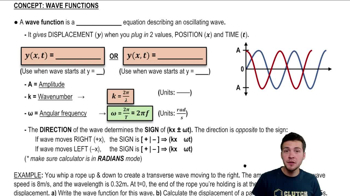
Wave Function

The wave function describes the characteristics of a wave, including its amplitude, wavelength, frequency, and phase. In the given equation, D(y,t) represents the displacement of the wave at position y and time t, with parameters indicating how the wave propagates through space and time.
Recommended video:
Guided course
08:30
Intro to Wave Functions

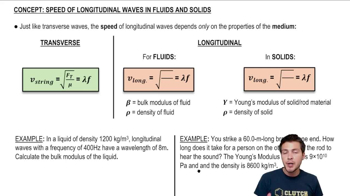
Transverse vs. Longitudinal Waves

Waves can be classified as transverse or longitudinal based on the direction of particle oscillation relative to wave propagation. In sound waves, which are longitudinal, the oscillation of air particles occurs parallel to the direction of wave travel, leading to compressions and rarefactions in the medium.
Recommended video:
Guided course
05:40
Speed of Longitudinal Waves (Fluids & Solids)

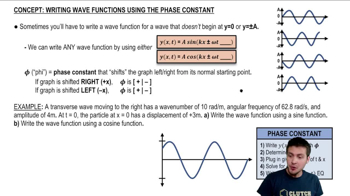
Phase of a Wave

The phase of a wave indicates its position in the cycle of oscillation at a given point in time. The term π/4 rad in the wave equation represents the initial phase shift, which affects how the wave starts oscillating at t=0, but does not change the fundamental nature of the oscillation direction.
Recommended video:
Guided course
08:59
Phase Constant of a Wave Function
Related Practice
Textbook Question

FIGURE P16.57 shows a snapshot graph of a wave traveling to the right along a string at 45 m/s. At this instant, what is the velocity of points 1, 2, and 3 on the string?

9
views

Textbook Question

One cue your hearing system uses to localize a sound (i.e., to tell where a sound is coming from) is the slight difference in the arrival times of the sound at your ears. Your ears are spaced approximately 20 cm apart. Consider a sound source 5.0 m from the center of your head along a line 45° to your right. What is the difference in arrival times? Give your answer in microseconds. Hint: You are looking for the difference between two numbers that are nearly the same. What does this near equality imply about the necessary precision during intermediate stages of the calculation?

4
views
Textbook Question

A 20.0-cm-long, 10.0-cm-diameter cylinder with a piston at one end contains 1.34 kg of an unknown liquid. Using the piston to compress the length of the liquid by 1.00 mm increases the pressure by 41.0 atm. What is the speed of sound in the liquid?

2
views
Textbook Question

The string in FIGURE P16.59 has linear density μ. Find an expression in terms of M, μ, and θ for the speed of waves on the string.

5
views
Textbook Question

Earthquakes are essentially sound waves—called seismic waves—traveling through the earth. Because the earth is solid, it can support both longitudinal and transverse seismic waves. The speed of longitudinal waves, called P waves, is 8000 m/s. Transverse waves, called S waves, travel at a slower 4500 m/s. A seismograph records the two waves from a distant earthquake. If the S wave arrives 2.0 min after the P wave, how far away was the earthquake? You can assume that the waves travel in straight lines, although actual seismic waves follow more complex routes.

1
views
Textbook Question

A wave on a string is described by D(x,t)=(2.00cm)×sin[(12.57rad/m)x(638rad/s)t]D(x,t) = (2.00 \, \(\text{cm}\)) \(\times\) \(\sin\)[(12.57 \, \(\text{rad/m}\))x - (638 \, \(\text{rad/s}\)) t], where xx is in mm and tt in ss. The linear density of the string is 5.00 g/m5.00\(\text{ g/m}\). What are The maximum speed of a point on the string?