
Textbook Question
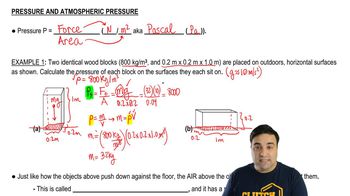
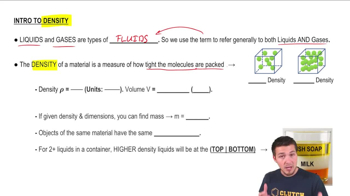
An aquarium of length L, width (front to back) W, and depth D is filled to the top with liquid of density ρ. Find an expression for the force of the liquid on the front window of the aquarium.
1
views

 Verified step by step guidance
 17:04
17:04
 8:13
8:13 10:13
10:13An aquarium of length L, width (front to back) W, and depth D is filled to the top with liquid of density ρ. Find an expression for the force of the liquid on the front window of the aquarium.
It's possible to use the ideal-gas law to show that the density of the earth's atmosphere decreases exponentially with height. That is, ρ = ρ₀ exp (-z/z₀), where z is the height above sea level, ρ₀ is the density at sea level (you can use the Table 14.1 value), and z₀ is called the scale height of the atmosphere. What is the density of the air in Denver, at an elevation of 1600 m? What percent of sea-level density is this?
A friend asks you how much pressure is in your car tires. You know that the tire manufacturer recommends 30 psi, but it's been a while since you've checked. You can't find a tire gauge in the car, but you do find the owner's manual and a ruler. Fortunately, you've just finished taking physics, so you tell your friend, 'I don't know, but I can figure it out.' From the owner's manual you find that the car's mass is 1500 kg. It seems reasonable to assume that each tire supports one-fourth of the weight. With the ruler you find that the tires are 15 cm wide and the flattened segment of the tire in contact with the road is 13 cm long. What answer—in psi—will you give your friend?
A 55 kg cheerleader uses an oil-filled hydraulic lift to hold four 110 kg football players at a height of 1.0 m. If her piston is 16 cm in diameter, what is the diameter of the football players' piston?
The average density of the body of a fish is 1080 kg/m³ . To keep from sinking, a fish increases its volume by inflating an internal air bladder, known as a swim bladder, with air. By what percent must the fish increase its volume to be neutrally buoyant in fresh water? The density of air at 20°C is 119 kg/m³.
When a second student joins the first, the piston sinks. What is the second student's mass?