
Ch 14: Fluids and Elasticity
Knight Calc - Physics for Scientists and Engineers 5th Edition
Knight Calc5th EditionPhysics for Scientists and EngineersISBN: 9780137344796Not the one you use?Change textbook
Chapter 14, Problem 42

A friend asks you how much pressure is in your car tires. You know that the tire manufacturer recommends 30 psi, but it's been a while since you've checked. You can't find a tire gauge in the car, but you do find the owner's manual and a ruler. Fortunately, you've just finished taking physics, so you tell your friend, 'I don't know, but I can figure it out.' From the owner's manual you find that the car's mass is 1500 kg. It seems reasonable to assume that each tire supports one-fourth of the weight. With the ruler you find that the tires are 15 cm wide and the flattened segment of the tire in contact with the road is 13 cm long. What answer—in psi—will you give your friend?

Verified step by step guidance
1
Step 1: Calculate the total weight of the car using the formula for weight: \( W = m \cdot g \), where \( m \) is the mass of the car (1500 kg) and \( g \) is the acceleration due to gravity (approximately \( 9.8 \, \text{m/s}^2 \)).
Step 2: Determine the weight supported by each tire. Since the car has four tires and the weight is evenly distributed, divide the total weight by 4.
Step 3: Calculate the contact area of one tire with the road. The contact area is a rectangle, so use the formula \( A = \text{width} \cdot \text{length} \), where the width is 15 cm (convert to meters: \( 0.15 \, \text{m} \)) and the length is 13 cm (convert to meters: \( 0.13 \, \text{m} \)).
Step 4: Compute the pressure exerted by one tire using the formula \( P = \frac{F}{A} \), where \( F \) is the weight supported by one tire (from Step 2) and \( A \) is the contact area (from Step 3). Ensure the pressure is in pascals (\( \text{Pa} \)).
Step 5: Convert the pressure from pascals to psi. Use the conversion factor \( 1 \, \text{psi} = 6894.76 \, \text{Pa} \). Divide the pressure in pascals by 6894.76 to express the result in psi.

Verified video answer for a similar problem:

This video solution was recommended by our tutors as helpful for the problem above.
Video duration:
6m
Was this helpful?

Key Concepts

Here are the essential concepts you must grasp in order to answer the question correctly.

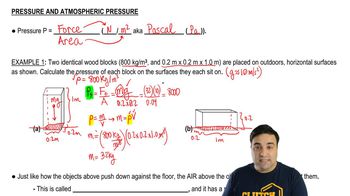
Pressure

Pressure is defined as the force exerted per unit area. In the context of tires, it is the force that the air inside the tire exerts on the inner walls of the tire, distributed over the contact area with the ground. The standard unit of pressure is pascals (Pa), but in the automotive context, it is often expressed in pounds per square inch (psi). Understanding how to calculate pressure is essential for determining if the tire is inflated to the recommended level.
Recommended video:
Guided course
17:04
Pressure and Atmospheric Pressure

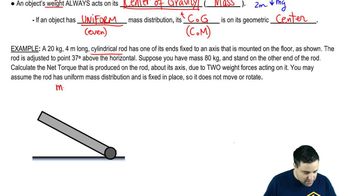
Force and Weight Distribution

The weight of an object is the force due to gravity acting on it, calculated as the mass multiplied by the acceleration due to gravity (approximately 9.81 m/s²). In this scenario, the total weight of the car is distributed evenly across its four tires, meaning each tire supports one-fourth of the total weight. This distribution is crucial for calculating the force acting on each tire, which is necessary for determining the pressure.
Recommended video:
Guided course
10:19
Torque Due to Weight

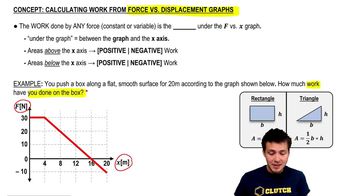
Area of Contact

The area of contact refers to the surface area of the tire that is in direct contact with the ground. In this case, it is determined by the width and length of the flattened segment of the tire. The area is critical in calculating pressure, as pressure is inversely proportional to the area over which the force is applied. A smaller contact area results in higher pressure for the same force, while a larger area results in lower pressure.
Recommended video:
Guided course
04:05
Calculating Work As Area Under F-x Graphs