
Ch 14: Fluids and Elasticity
Knight Calc - Physics for Scientists and Engineers 5th Edition
Knight Calc5th EditionPhysics for Scientists and EngineersISBN: 9780137344796Not the one you use?Change textbook
Chapter 14, Problem 56

A nuclear power plant draws 3.0 x 10⁶ L/min of cooling water from the ocean. If the water is drawn in through two parallel, 3.0-m-diameter pipes, what is the water speed in each pipe?

Verified step by step guidance
1
Step 1: Start by calculating the total volumetric flow rate of water in cubic meters per second. Convert the given flow rate from liters per minute to cubic meters per second using the conversion factors: 1 liter = 0.001 cubic meters and 1 minute = 60 seconds. The formula is: \( Q = (3.0 \times 10^6 \text{ L/min}) \times (0.001 \text{ m}^3/\text{L}) \div 60 \text{ s/min} \).
Step 2: Since the water is drawn through two parallel pipes, divide the total volumetric flow rate by 2 to find the flow rate through each pipe. Let this be \( Q_{\text{pipe}} \). The formula is: \( Q_{\text{pipe}} = Q \div 2 \).
Step 3: Use the relationship between volumetric flow rate, cross-sectional area, and velocity to find the water speed in each pipe. The formula is: \( Q_{\text{pipe}} = A \cdot v \), where \( A \) is the cross-sectional area of the pipe and \( v \) is the water speed. Rearrange to solve for \( v \): \( v = Q_{\text{pipe}} \div A \).
Step 4: Calculate the cross-sectional area of one pipe using the formula for the area of a circle: \( A = \pi r^2 \), where \( r \) is the radius of the pipe. The radius is half the diameter, so \( r = 3.0 \text{ m} \div 2 \). Substitute this value into the area formula.
Step 5: Substitute the values of \( Q_{\text{pipe}} \) and \( A \) into the formula \( v = Q_{\text{pipe}} \div A \) to find the water speed in each pipe. Ensure all units are consistent (e.g., cubic meters per second for \( Q_{\text{pipe}} \) and square meters for \( A \)).

Verified video answer for a similar problem:

This video solution was recommended by our tutors as helpful for the problem above.
Video duration:
4m
Was this helpful?

Key Concepts

Here are the essential concepts you must grasp in order to answer the question correctly.

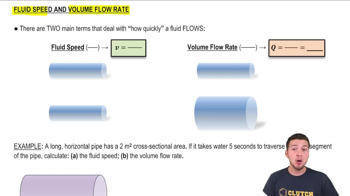
Flow Rate

Flow rate is the volume of fluid that passes through a given surface per unit time, typically measured in liters per minute (L/min) or cubic meters per second (m³/s). In this context, the total flow rate of 3.0 x 10⁶ L/min must be distributed between the two parallel pipes, which is essential for calculating the speed of water in each pipe.
Recommended video:
Guided course
6:34
Fluid Speed & Volume Flow Rate

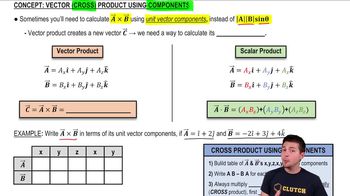
Cross-Sectional Area

The cross-sectional area of a pipe is the area of the circular face of the pipe through which the fluid flows. It can be calculated using the formula A = π(d/2)², where d is the diameter of the pipe. Understanding the cross-sectional area is crucial for determining the velocity of the water, as it relates the flow rate to the speed of the fluid.
Recommended video:
Guided course
08:10
Calculating the Vector (Cross) Product Using Components

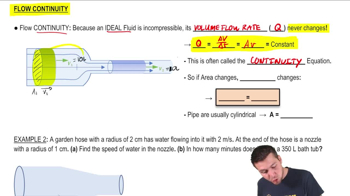
Continuity Equation

The continuity equation in fluid dynamics states that the mass flow rate must remain constant from one cross-section of a pipe to another. For incompressible fluids, this means that the product of the cross-sectional area and the fluid velocity is constant. This principle allows us to relate the total flow rate to the speed of water in each individual pipe.
Recommended video:
Guided course
11:08
Flow Continuity
Related Practice
Textbook Question

One day when you come into physics lab you find several plastic hemispheres floating like boats in a tank of fresh water. Each lab group is challenged to determine the heaviest rock that can be placed in the bottom of a plastic boat without sinking it. You get one try. Sinking the boat gets you no points, and the maximum number of points goes to the group that can place the heaviest rock without sinking. You begin by measuring one of the hemispheres, finding that it has a mass of 21 g and a diameter of 8.0 cm. What is the mass of the heaviest rock that, in perfectly still water, won't sink the plastic boat?

1
views
Textbook Question

A pressure gauge reads 50 kPa as water flows at 10.0 m/s through a 16.8-cm-diameter horizontal pipe. What is the reading of a pressure gauge after the pipe has expanded to 20.0 cm in diameter?

1
views
Textbook Question

It's possible to use the ideal-gas law to show that the density of the earth's atmosphere decreases exponentially with height. That is, ρ = ρ₀ exp (-z/z₀), where z is the height above sea level, ρ₀ is the density at sea level (you can use the Table 14.1 value), and z₀ is called the scale height of the atmosphere. What is the density of the air in Denver, at an elevation of 1600 m? What percent of sea-level density is this?

2
views
Textbook Question

A nonviscous liquid of density p flows at speed v₀ through a horizontal pipe that expands smoothly from diameter d₀ to a larger diameter d₁. The pressure in the narrower section is p₀. Find an expression for the pressure p₁ in the wider section.

2
views
Textbook Question

A tree loses water to the air by the process of transpiration at the rate of 110 g/h. This water is replaced by the upward flow of sap through vessels in the trunk. If the trunk contains 2000 vessels, each 100 μm in diameter, what is the upward speed in mm/s of the sap in each vessel? The density of tree sap is 1040 kg/m³.

1
views
Textbook Question

The average density of the body of a fish is 1080 kg/m³ . To keep from sinking, a fish increases its volume by inflating an internal air bladder, known as a swim bladder, with air. By what percent must the fish increase its volume to be neutrally buoyant in fresh water? The density of air at 20°C is 119 kg/m³.

1
views