Ch 14: Fluids and Elasticity
Knight Calc - Physics for Scientists and Engineers 5th Edition
Knight Calc5th EditionPhysics for Scientists and EngineersISBN: 9780137344796Not the one you use?Change textbook
Chapter 14, Problem 57b

A pressure gauge reads 50 kPa as water flows at 10.0 m/s through a 16.8-cm-diameter horizontal pipe. What is the reading of a pressure gauge after the pipe has expanded to 20.0 cm in diameter?

Verified step by step guidance
1
Start by identifying the principle governing the problem: Bernoulli's equation, which relates pressure, velocity, and height in a fluid flow. Since the pipe is horizontal, the height term cancels out.
Write Bernoulli's equation for the two points in the pipe: \( P_1 + \frac{1}{2} \rho v_1^2 = P_2 + \frac{1}{2} \rho v_2^2 \), where \( P_1 \) and \( P_2 \) are pressures, \( v_1 \) and \( v_2 \) are velocities, and \( \rho \) is the density of water.
Use the continuity equation to relate the velocities at the two points: \( A_1 v_1 = A_2 v_2 \), where \( A_1 \) and \( A_2 \) are the cross-sectional areas of the pipe at the two points. Calculate \( A_1 \) and \( A_2 \) using \( A = \pi r^2 \), where \( r \) is the radius of the pipe.
Solve the continuity equation for \( v_2 \): \( v_2 = \frac{A_1}{A_2} v_1 \). Substitute the values of \( A_1 \), \( A_2 \), and \( v_1 \) to find \( v_2 \).
Substitute \( v_1 \) and \( v_2 \) into Bernoulli's equation to solve for \( P_2 \): \( P_2 = P_1 + \frac{1}{2} \rho (v_1^2 - v_2^2) \). Use the given \( P_1 \), \( v_1 \), and the calculated \( v_2 \) to find the new pressure reading.

Verified video answer for a similar problem:

This video solution was recommended by our tutors as helpful for the problem above.
Video duration:
10m
Was this helpful?

Key Concepts

Here are the essential concepts you must grasp in order to answer the question correctly.

Bernoulli's Principle

Bernoulli's Principle states that in a flowing fluid, an increase in the fluid's speed occurs simultaneously with a decrease in pressure or potential energy. This principle is fundamental in understanding how fluid dynamics work, particularly in varying cross-sectional areas of pipes, where the velocity and pressure of the fluid are inversely related.
Recommended video:
Guided course
14:47
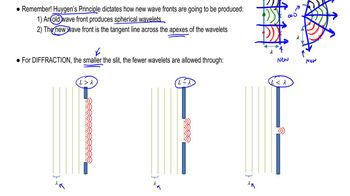
Diffraction with Huygen's Principle

Continuity Equation

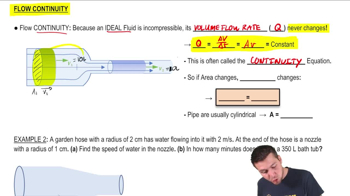
The Continuity Equation is a fundamental principle in fluid dynamics that asserts that the mass flow rate must remain constant from one cross-section of a pipe to another. For incompressible fluids, this means that the product of the cross-sectional area and the fluid velocity is constant, allowing us to relate the velocities and diameters of the pipe at different points.
Recommended video:
Guided course
11:08
Flow Continuity

Pressure Measurement in Fluids

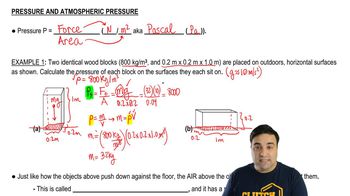
Pressure in fluids is defined as the force exerted per unit area and can vary with changes in fluid velocity and pipe diameter. In the context of a pressure gauge, it measures the static pressure of the fluid, which can be influenced by factors such as flow speed and pipe geometry, making it essential to apply Bernoulli's Principle and the Continuity Equation to determine pressure changes in the system.
Recommended video:
Guided course
17:04
Pressure and Atmospheric Pressure
Related Practice
Textbook Question

Water from a vertical pipe emerges as a 10-cm-diameter cylinder and falls straight down 7.5 m into a bucket. The water exits the pipe with a speed of 2.0 m/s. What is the diameter of the column of water as it hits the bucket?

1
views
Textbook Question

One day when you come into physics lab you find several plastic hemispheres floating like boats in a tank of fresh water. Each lab group is challenged to determine the heaviest rock that can be placed in the bottom of a plastic boat without sinking it. You get one try. Sinking the boat gets you no points, and the maximum number of points goes to the group that can place the heaviest rock without sinking. You begin by measuring one of the hemispheres, finding that it has a mass of 21 g and a diameter of 8.0 cm. What is the mass of the heaviest rock that, in perfectly still water, won't sink the plastic boat?

1
views
Textbook Question

A nonviscous liquid of density p flows at speed v₀ through a horizontal pipe that expands smoothly from diameter d₀ to a larger diameter d₁. The pressure in the narrower section is p₀. Find an expression for the pressure p₁ in the wider section.

2
views
Textbook Question

A tree loses water to the air by the process of transpiration at the rate of 110 g/h. This water is replaced by the upward flow of sap through vessels in the trunk. If the trunk contains 2000 vessels, each 100 μm in diameter, what is the upward speed in mm/s of the sap in each vessel? The density of tree sap is 1040 kg/m³.

1
views
Textbook Question

A nuclear power plant draws 3.0 x 10⁶ L/min of cooling water from the ocean. If the water is drawn in through two parallel, 3.0-m-diameter pipes, what is the water speed in each pipe?

1
views
Textbook Question

A hurricane wind blows across a 6.0 m x 15.0 m flat roof at a speed of 130 km/h. What is the pressure difference?

1
views