Ch 13: Newton's Theory of Gravity
Knight Calc - Physics for Scientists and Engineers 5th Edition
Knight Calc5th EditionPhysics for Scientists and EngineersISBN: 9780137344796Not the one you use?Change textbook
Chapter 13, Problem 60

Three stars, each with the mass of our sun, form an equilateral triangle with sides 1.0 x 10¹² m long. (This triangle would just about fit within the orbit of Jupiter.) The triangle has to rotate, because otherwise the stars would crash together in the center. What is the period of rotation?

Verified step by step guidance
1
Step 1: Begin by identifying the forces acting on each star. Each star experiences a gravitational force due to the other two stars. Use Newton's law of gravitation to calculate the magnitude of the gravitational force between two stars: \( F = \frac{G m_1 m_2}{r^2} \), where \( G \) is the gravitational constant, \( m_1 \) and \( m_2 \) are the masses of the stars, and \( r \) is the distance between them.
Step 2: Since the stars form an equilateral triangle, the net gravitational force on each star will point toward the center of the triangle. Decompose the forces into components and calculate the net force acting toward the center using symmetry and vector addition.
Step 3: For the system to rotate without collapsing, the centripetal force required for circular motion must equal the net gravitational force acting on each star. Use the centripetal force formula \( F_c = \frac{m v^2}{r_c} \), where \( v \) is the tangential velocity and \( r_c \) is the distance from the center of rotation to each star.
Step 4: Relate the tangential velocity \( v \) to the period of rotation \( T \) using \( v = \frac{2 \pi r_c}{T} \). Substitute this expression for \( v \) into the centripetal force equation and solve for \( T \).
Step 5: Combine the equations from Step 1, Step 3, and Step 4 to express the period \( T \) in terms of \( G \), \( m \), and \( r \). Simplify the expression to find the final formula for the period of rotation.

Verified video answer for a similar problem:

This video solution was recommended by our tutors as helpful for the problem above.
Video duration:
11m
Was this helpful?

Key Concepts

Here are the essential concepts you must grasp in order to answer the question correctly.

Gravitational Force

The gravitational force is the attractive force between two masses, described by Newton's law of universal gravitation. It states that the force is proportional to the product of the masses and inversely proportional to the square of the distance between their centers. In this scenario, the gravitational interactions between the three stars will influence their motion and stability in the triangular formation.
Recommended video:
Guided course
05:41
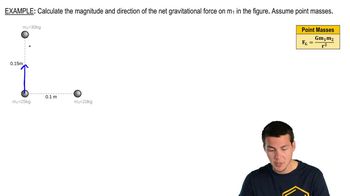
Gravitational Forces in 2D

Centripetal Force

Centripetal force is the net force that acts on an object moving in a circular path, directed towards the center of the circle. For the stars in the equilateral triangle, this force is necessary to keep them in their circular orbits around the center of mass. The gravitational force between the stars provides the required centripetal force to maintain their rotation without collapsing into each other.
Recommended video:
Guided course
06:48
Intro to Centripetal Forces

Rotational Dynamics

Rotational dynamics involves the study of the motion of objects that are rotating and the forces that cause this motion. In this case, the period of rotation refers to the time it takes for the stars to complete one full rotation around their common center of mass. Understanding the relationship between mass, distance, and angular velocity is crucial for calculating the period of rotation in this gravitational system.
Recommended video:
Guided course
08:12
Torque & Acceleration (Rotational Dynamics)
Related Practice
Textbook Question

Two Jupiter-size planets are released from rest 1.0 x 10¹¹ m apart. What are their speeds as they crash together?

3
views

Textbook Question

The solar system is 25,000 light years from the center of our Milky Way galaxy. One light year is the distance light travels in one year at a speed of 3.0 x 10⁶ m/s . Astronomers have determined that the solar system is orbiting the center of the galaxy at a speed of 230 km/s . Our solar system was formed roughly 5 billion years ago. How many orbits has it completed?

2
views
Textbook Question

Comets move around the sun in very elliptical orbits. At its closet approach, in 1986, Comet Halley was 8.79 x 10⁷ km from the sun and moving with a speed of 54.6 km/s. What was the comet’s speed when it crossed Neptune’s orbit in 2006?

Textbook Question

A 55,000 kg space capsule is in a 28,000-km-diameter circular orbit around the moon. A brief but intense firing of its engine in the forward direction suddenly decreases its speed by 50%. This causes the space capsule to go into an elliptical orbit. What are the space capsule’s (a) maximum and (b) minimum distances from the center of the moon in its new orbit? Hint: You will need to use two conservation laws.

Textbook Question

The solar system is 25,000 light years from the center of our Milky Way galaxy. One light year is the distance light travels in one year at a speed of 3.0 x 10⁸ m/s. Astronomers have determined that the solar system is orbiting the center of the galaxy at a speed of 230 km/s. The gravitational force on the solar system is the net force due to all the matter inside our orbit. Most of that matter is concentrated near the center of the galaxy. Assume that the matter has a spherical distribution, like a giant star. What is the approximate mass of the galactic center?

3
views
Textbook Question

The solar system is 25,000 light years from the center of our Milky Way galaxy. One light year is the distance light travels in one year at a speed of 3.0 x 10⁸ m/s. Astronomers have determined that the solar system is orbiting the center of the galaxy at a speed of 230 km/s. Assume that the sun is a typical star with a typical mass. If galactic matter is made up of stars, approximately how many stars are in the center of the galaxy?

1
views