

Ch 13: Newton's Theory of Gravity
Knight Calc - Physics for Scientists and Engineers 5th Edition
Knight Calc5th EditionPhysics for Scientists and EngineersISBN: 9780137344796Not the one you use?Change textbook
Chapter 13, Problem 59d

The solar system is 25,000 light years from the center of our Milky Way galaxy. One light year is the distance light travels in one year at a speed of 3.0 x 10⁸ m/s. Astronomers have determined that the solar system is orbiting the center of the galaxy at a speed of 230 km/s. Assume that the sun is a typical star with a typical mass. If galactic matter is made up of stars, approximately how many stars are in the center of the galaxy?

Verified step by step guidance
1
Step 1: Calculate the distance from the solar system to the center of the galaxy in meters. Start by converting 25,000 light years into meters. Use the fact that 1 light year is the distance light travels in one year, which is given by the formula: \( d = c \cdot t \), where \( c = 3.0 \times 10^8 \, \text{m/s} \) and \( t = 1 \, \text{year} = 365.25 \, \text{days} \cdot 24 \, \text{hours/day} \cdot 3600 \, \text{seconds/hour} \).
Step 2: Use the orbital speed of the solar system (230 km/s) to calculate the orbital period (time for one complete orbit) around the center of the galaxy. The formula for the orbital period is \( T = \frac{2 \pi r}{v} \), where \( r \) is the distance from the center of the galaxy (calculated in Step 1) and \( v = 230 \, \text{km/s} = 230,000 \, \text{m/s} \).
Step 3: Apply Newton's version of Kepler's third law to estimate the total mass of the galaxy within the solar system's orbit. The formula is \( M = \frac{r^3}{G T^2} \), where \( G = 6.674 \times 10^{-11} \, \text{m}^3 \, \text{kg}^{-1} \, \text{s}^{-2} \) is the gravitational constant, \( r \) is the orbital radius (from Step 1), and \( T \) is the orbital period (from Step 2).
Step 4: Estimate the number of stars in the galaxy by dividing the total mass of the galaxy (calculated in Step 3) by the average mass of a typical star. Assume the mass of a typical star is approximately equal to the mass of the sun, \( M_\odot = 1.989 \times 10^{30} \, \text{kg} \). Use the formula: \( N = \frac{M}{M_\odot} \).
Step 5: Interpret the result from Step 4 as the approximate number of stars in the center of the galaxy. This assumes that the mass of the galaxy is primarily composed of stars and neglects contributions from dark matter or other components.

Verified video answer for a similar problem:

This video solution was recommended by our tutors as helpful for the problem above.
Video duration:
2m
Was this helpful?

Key Concepts

Here are the essential concepts you must grasp in order to answer the question correctly.

Light Year

A light year is a unit of distance that represents how far light travels in one year. Given that light moves at a speed of approximately 3.0 x 10⁸ meters per second, one light year is equivalent to about 9.46 trillion kilometers. This concept is crucial for understanding astronomical distances, such as the distance from the solar system to the center of the Milky Way galaxy.
Recommended video:
10:30
Ray Nature of Light

Orbital Velocity

Orbital velocity is the speed at which an object must travel to maintain a stable orbit around a larger body due to gravitational forces. In the context of the solar system, the sun orbits the center of the Milky Way at a speed of 230 km/s. This concept helps in calculating the gravitational influence of the mass within the galaxy, which is essential for estimating the number of stars in the galactic center.
Recommended video:
Guided course
04:45
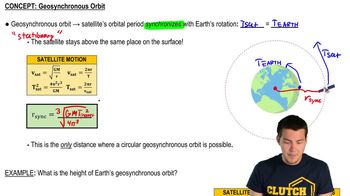
Geosynchronous Orbits

Mass of Stars and Galactic Matter

The mass of stars and other galactic matter plays a significant role in the dynamics of galaxies. By assuming the sun is a typical star, we can estimate the total mass of stars in the galaxy's center. The gravitational pull of this mass affects the orbital velocities of stars, allowing astronomers to infer the number of stars based on the observed motion and distribution of matter in the galaxy.
Recommended video:
Guided course
06:36
Star collapses
Related Practice
Textbook Question

The solar system is 25,000 light years from the center of our Milky Way galaxy. One light year is the distance light travels in one year at a speed of 3.0 x 10⁶ m/s . Astronomers have determined that the solar system is orbiting the center of the galaxy at a speed of 230 km/s . Our solar system was formed roughly 5 billion years ago. How many orbits has it completed?

2
views
Textbook Question

Comets move around the sun in very elliptical orbits. At its closet approach, in 1986, Comet Halley was 8.79 x 10⁷ km from the sun and moving with a speed of 54.6 km/s. What was the comet’s speed when it crossed Neptune’s orbit in 2006?

Textbook Question

Three stars, each with the mass of our sun, form an equilateral triangle with sides 1.0 x 10¹² m long. (This triangle would just about fit within the orbit of Jupiter.) The triangle has to rotate, because otherwise the stars would crash together in the center. What is the period of rotation?

1
views
Textbook Question

A 55,000 kg space capsule is in a 28,000-km-diameter circular orbit around the moon. A brief but intense firing of its engine in the forward direction suddenly decreases its speed by 50%. This causes the space capsule to go into an elliptical orbit. What are the space capsule’s (a) maximum and (b) minimum distances from the center of the moon in its new orbit? Hint: You will need to use two conservation laws.

Textbook Question

Large stars can explode as they finish burning their nuclear fuel, causing a supernova. The explosion blows away the outer layers of the star. According to Newton's third law, the forces that push the outer layers away have reaction forces that are inwardly directed on the core of the star. These forces compress the core and can cause the core to undergo a gravitational collapse. The gravitational forces keep pulling all the matter together tighter and tighter, crushing atoms out of existence. Under these extreme conditions, a proton and an electron can be squeezed together to form a neutron. If the collapse is halted when the neutrons all come into contact with each other, the result is an object called a neutron star, an entire star consisting of solid nuclear matter. Many neutron stars rotate about their axis with a period of ≈ 1 s and, as they do so, send out a pulse of electromagnetic waves once a second. These stars were discovered in the 1960s and are called pulsars. What is the radius of a geosynchronous orbit?

2
views
Textbook Question

The solar system is 25,000 light years from the center of our Milky Way galaxy. One light year is the distance light travels in one year at a speed of 3.0 x 10⁸ m/s. Astronomers have determined that the solar system is orbiting the center of the galaxy at a speed of 230 km/s. The gravitational force on the solar system is the net force due to all the matter inside our orbit. Most of that matter is concentrated near the center of the galaxy. Assume that the matter has a spherical distribution, like a giant star. What is the approximate mass of the galactic center?

3
views