
Textbook Question
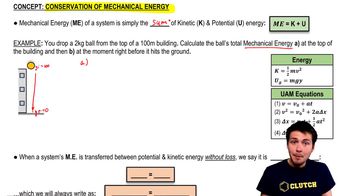
Two Jupiter-size planets are released from rest 1.0 x 10¹¹ m apart. What are their speeds as they crash together?
3
views

 Verified step by step guidance
 06:24
06:24
 12:12
12:12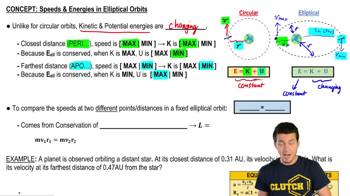 6:03
6:03Two Jupiter-size planets are released from rest 1.0 x 10¹¹ m apart. What are their speeds as they crash together?
Comets move around the sun in very elliptical orbits. At its closet approach, in 1986, Comet Halley was 8.79 x 10⁷ km from the sun and moving with a speed of 54.6 km/s. What was the comet’s speed when it crossed Neptune’s orbit in 2006?
Three stars, each with the mass of our sun, form an equilateral triangle with sides 1.0 x 10¹² m long. (This triangle would just about fit within the orbit of Jupiter.) The triangle has to rotate, because otherwise the stars would crash together in the center. What is the period of rotation?
While visiting Planet Physics, you toss a rock straight up at 11 m/s and catch it 2.5 s later. While you visit the surface, your cruise ship orbits at an altitude equal to the planet's radius every 230 min. What are the (a) mass and (b) radius of Planet Physics?
A satellite in a circular orbit of radius r has period T. A satellite in a nearby orbit with radius r + Δr, where Δr ≪ r, has the very slightly different period T + ΔT. Show that ΔT/T = (3/2) (Δr/r)
The solar system is 25,000 light years from the center of our Milky Way galaxy. One light year is the distance light travels in one year at a speed of 3.0 x 10⁸ m/s. Astronomers have determined that the solar system is orbiting the center of the galaxy at a speed of 230 km/s. Assume that the sun is a typical star with a typical mass. If galactic matter is made up of stars, approximately how many stars are in the center of the galaxy?