Ch 12: Rotation of a Rigid Body
Knight Calc - Physics for Scientists and Engineers 5th Edition
Knight Calc5th EditionPhysics for Scientists and EngineersISBN: 9780137344796Not the one you use?Change textbook
Chapter 12, Problem 29

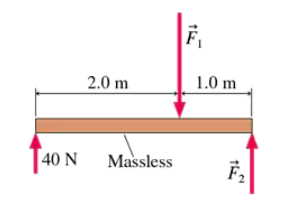
The object shown in FIGURE EX12.29 is in equilibrium. What are the magnitudes of F1\(\overrightarrow{F_1}\)_{} and F2\(\overrightarrow{F_2}\)_{}?

Verified step by step guidance
1
Step 1: Identify the forces acting on the object. The object is in equilibrium, meaning the net force and net torque acting on it are zero. The forces include the downward force of 50 N, and the upward forces F1 and F2.
Step 2: Apply the condition for equilibrium in the vertical direction. The sum of upward forces must equal the sum of downward forces: F1+F2=50.
Step 3: Apply the condition for rotational equilibrium. Choose the left end of the object as the pivot point. The sum of clockwise torques must equal the sum of counterclockwise torques. The torque due to F1 is F1×3.0, and the torque due to F2 is F2×5.0. The torque due to the 50 N force is 50×0 (since it acts at the pivot point). Set up the equation: F1×3.0=F2×5.0.
Step 4: Solve the system of equations. Use the two equations derived: F1+F2=50 and F1×3.0=F2×5.0. Substitute one equation into the other to find F1 and F2.
Step 5: Verify the solution. Check that the values of F1 and F2 satisfy both the force equilibrium and torque equilibrium conditions. Ensure that the object remains in equilibrium under the calculated forces.

Verified video answer for a similar problem:

This video solution was recommended by our tutors as helpful for the problem above.
Video duration:
8m
Was this helpful?

Key Concepts

Here are the essential concepts you must grasp in order to answer the question correctly.

Equilibrium

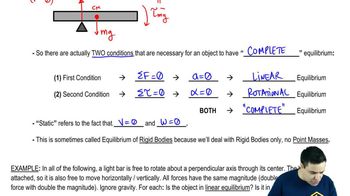
Equilibrium in physics refers to a state where the net force and net torque acting on an object are both zero. This means that the object is either at rest or moving with a constant velocity. In the context of the question, the beam is in equilibrium, indicating that the upward forces (F1 and F2) must balance the downward force (50N) acting on it.
Recommended video:
Guided course
10:13
Torque & Equilibrium

Torque

Torque is a measure of the rotational force applied to an object, calculated as the product of the force and the distance from the pivot point (lever arm). In this scenario, the torques created by forces F1 and F2 about a chosen pivot point must also balance out to maintain equilibrium. Understanding how to calculate and set these torques equal is crucial for solving the problem.
Recommended video:
Guided course
08:55
Net Torque & Sign of Torque

Force Components

Force components refer to the individual forces acting in different directions that can be resolved into their respective horizontal and vertical components. In this problem, F1 and F2 are the forces acting vertically to counteract the 50N downward force. Analyzing these components helps in setting up the equations needed to find the magnitudes of F1 and F2.
Recommended video:
Guided course
07:30
Vector Addition By Components