Ch 12: Rotation of a Rigid Body
Knight Calc - Physics for Scientists and Engineers 5th Edition
Knight Calc5th EditionPhysics for Scientists and EngineersISBN: 9780137344796Not the one you use?Change textbook
Chapter 12, Problem 33c

A car tire is 60 cm in diameter. The car is traveling at a speed of 20 m/s. What is the speed of a point at the bottom edge of the tire?

Verified step by step guidance
1
Step 1: Understand the problem. The speed of a point at the bottom edge of the tire is influenced by both the translational motion of the car and the rotational motion of the tire. At the bottom edge, the rotational velocity of the tire opposes the translational velocity of the car.
Step 2: Recall the relationship between linear velocity and angular velocity. The linear velocity of a point on the edge of a rotating object is given by the formula: v=rω, where r is the radius of the tire and ω is the angular velocity.
Step 3: Calculate the radius of the tire. The diameter is given as 60 cm, so the radius is half of that: r=602=30 cm or 0.3 m.
Step 4: Determine the angular velocity of the tire. The car's translational speed is related to the tire's angular velocity by the formula: v=rω. Rearrange to solve for ω: ω=vr. Substitute v=20 m/s and r=0.3 m to find ω.
Step 5: Combine the translational and rotational velocities. At the bottom edge of the tire, the rotational velocity opposes the translational velocity. The total speed of the point at the bottom edge is given by: v=vtranslational-vrotational. Substitute the values to find the result.

Verified video answer for a similar problem:

This video solution was recommended by our tutors as helpful for the problem above.
Video duration:
2m
Was this helpful?

Key Concepts

Here are the essential concepts you must grasp in order to answer the question correctly.

Linear Speed

Linear speed refers to the distance traveled per unit of time by an object moving along a path. In this context, the car's speed of 20 m/s indicates how fast the entire vehicle is moving forward. Understanding linear speed is crucial for analyzing the motion of points on the tire, as it helps relate the speed of the car to the rotational motion of the tire.
Recommended video:
Guided course
07:31
Linear Thermal Expansion

Rotational Motion

Rotational motion describes the movement of an object around a central axis. For a tire, this involves the rotation about its center as it rolls. The relationship between linear speed and rotational speed is essential for determining how fast a point on the tire's edge moves, as the tire's rotation affects the speed of points on its circumference.
Recommended video:
Guided course
07:18
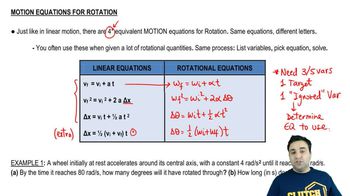
Equations of Rotational Motion

Point of Contact Speed

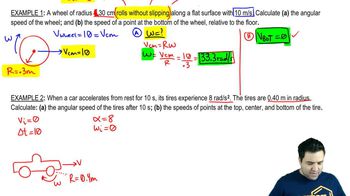
The speed of a point at the bottom edge of the tire, also known as the point of contact, is influenced by both the linear speed of the car and the rotational motion of the tire. When the tire rolls without slipping, the point of contact momentarily has a speed of zero relative to the ground. Thus, to find the speed of this point, one must consider the combination of the tire's rotation and the car's forward motion.
Recommended video:
Guided course
03:15
Speeds at points on a wheel