Ch 12: Rotation of a Rigid Body
Knight Calc - Physics for Scientists and Engineers 5th Edition
Knight Calc5th EditionPhysics for Scientists and EngineersISBN: 9780137344796Not the one you use?Change textbook
Chapter 12, Problem 32

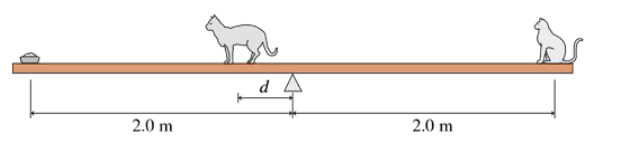
A 5.0 kg cat and a 2.0 kg bowl of tuna fish are at opposite ends of the 4.0-m-long seesaw of FIGURE EX12.32. How far to the left of the pivot must a 4.0 kg cat stand to keep the seesaw balanced?

Verified step by step guidance
1
Step 1: Understand the concept of torque and equilibrium. Torque is the rotational equivalent of force, and for the seesaw to be balanced, the sum of clockwise torques must equal the sum of counterclockwise torques. The formula for torque is τ = F × d, where F is the force (weight) and d is the distance from the pivot point.
Step 2: Calculate the torque produced by the 5.0 kg cat. The weight of the cat is given by F = m × g, where m is the mass (5.0 kg) and g is the acceleration due to gravity (approximately 9.8 m/s²). The distance from the pivot is 2.0 m (half the length of the seesaw). Use the formula τ = F × d to find the torque.
Step 3: Calculate the torque produced by the 2.0 kg bowl of tuna fish. Similarly, the weight of the bowl is F = m × g, where m is 2.0 kg. The distance from the pivot is also 2.0 m. Use the formula τ = F × d to find the torque.
Step 4: Set up the equation for equilibrium. The torque produced by the 4.0 kg cat standing to the left of the pivot must balance the combined torques of the 5.0 kg cat and the 2.0 kg bowl. Let the distance of the 4.0 kg cat from the pivot be x. The torque produced by the 4.0 kg cat is τ = F × x, where F = m × g and m is 4.0 kg.
Step 5: Solve for x. Combine the torques from the 5.0 kg cat and the 2.0 kg bowl on one side of the equation and set it equal to the torque produced by the 4.0 kg cat. Rearrange the equation to isolate x, and solve for the distance the 4.0 kg cat must stand to the left of the pivot.

Verified video answer for a similar problem:

This video solution was recommended by our tutors as helpful for the problem above.
Video duration:
6m
Was this helpful?

Key Concepts

Here are the essential concepts you must grasp in order to answer the question correctly.

Torque

Torque is a measure of the rotational force applied to an object around a pivot point. It is calculated as the product of the force applied and the distance from the pivot point to the line of action of the force. In this scenario, the seesaw will balance when the torques produced by the weights of the cats and the bowl of tuna are equal.
Recommended video:
Guided course
08:55
Net Torque & Sign of Torque

Equilibrium

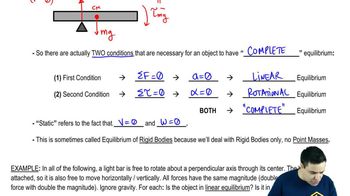
Equilibrium in physics refers to a state where all forces and torques acting on an object are balanced, resulting in no net force or rotation. For the seesaw to remain in equilibrium, the clockwise torque must equal the counterclockwise torque. This principle is essential for determining the position of the 4.0 kg cat needed to balance the seesaw.
Recommended video:
Guided course
10:13
Torque & Equilibrium

Center of Mass

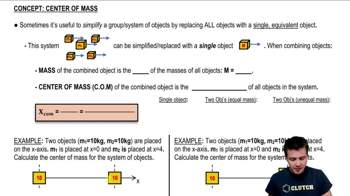
The center of mass is the point at which the mass of an object is concentrated and around which it balances. In the context of the seesaw, the positions of the cats and the bowl of tuna affect the overall center of mass, influencing how far the 4.0 kg cat must stand from the pivot to achieve balance. Understanding this concept helps in calculating the required distances for equilibrium.
Recommended video:
Guided course
06:30
Intro to Center of Mass