
A 12 kg weather rocket generates a thrust of 200 N. The rocket, pointing upward, is clamped to the top of a vertical spring. The bottom of the spring, whose spring constant is 550 N/m, is anchored to the ground. Initially, before the engine is ignited, the rocket sits at rest on top of the spring. How much is the spring compressed?
Draw a pictorial representation.
Verified step by step guidance
Verified video answer for a similar problem:
Key Concepts
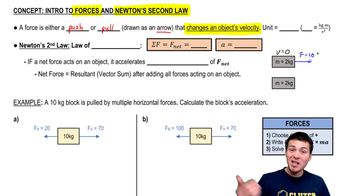
Newton's Second Law of Motion
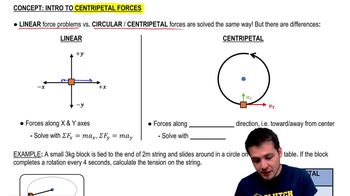
Tension Force
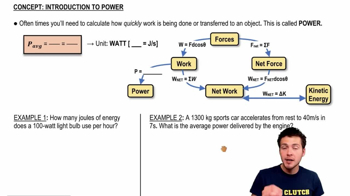
Power
Astronomers using a 2.0-m-diameter telescope observe a distant supernova - an exploding star. The telescope's detector records 9.1 x 10⁻¹¹ J of light energy during the first 10 s. It's known that this type of supernova has a visible-light power output of 5.0 x 1037 W for the first 10 s of the explosion. How distant is the supernova? Give your answer in light years, where one light year is the distance light travels in one year. The speed of light is 3.0 x 10⁸ m/s.
A 12 kg weather rocket generates a thrust of 200 N. The rocket, pointing upward, is clamped to the top of a vertical spring. The bottom of the spring, whose spring constant is 550 N/m, is anchored to the ground. After the engine is ignited, what is the rocket’s speed when the spring has stretched 40 cm?
Write a realistic problem for which this is the correct equation(s).
Finish the solution of the problem.
A farmer uses a tractor to pull a 150 kg bale of hay up a 15° incline to the barn at a steady 5.0 km/h. The coefficient of kinetic friction between the bale and the ramp is 0.45. What is the tractor's power output?
