
Astronomers using a 2.0-m-diameter telescope observe a distant supernova - an exploding star. The telescope's detector records 9.1 x 10⁻¹¹ J of light energy during the first 10 s. It's known that this type of supernova has a visible-light power output of 5.0 x 1037 W for the first 10 s of the explosion. How distant is the supernova? Give your answer in light years, where one light year is the distance light travels in one year. The speed of light is 3.0 x 10⁸ m/s.
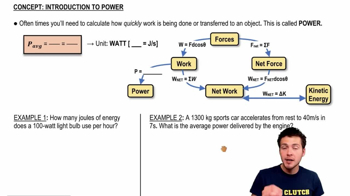
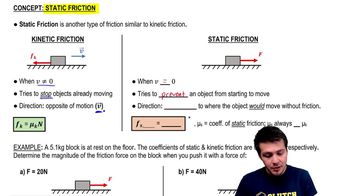
A farmer uses a tractor to pull a 150 kg bale of hay up a 15° incline to the barn at a steady 5.0 km/h. The coefficient of kinetic friction between the bale and the ramp is 0.45. What is the tractor's power output?
Verified step by step guidance
Verified video answer for a similar problem:
Key Concepts
Power
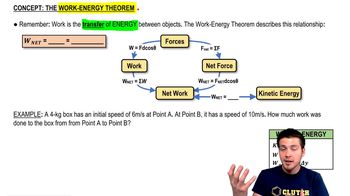
Work and Energy
Friction
Write a realistic problem for which this is the correct equation(s).
A Porsche 944 Turbo has a rated engine power of 217 hp. 30% of the power is lost in the engine and the drive train, and 70% reaches the wheels. The total mass of the car and driver is 1480 kg, and two-thirds of the weight is over the drive wheels. How long does it take the Porsche to reach the maximum power output?
A Porsche 944 Turbo has a rated engine power of 217 hp. 30% of the power is lost in the engine and the drive train, and 70% reaches the wheels. The total mass of the car and driver is 1480 kg, and two-thirds of the weight is over the drive wheels. If the Porsche accelerates at amax, what is its speed when it reaches maximum power output?
Draw a pictorial representation.
A Porsche 944 Turbo has a rated engine power of 217 hp. 30% of the power is lost in the engine and the drive train, and 70% reaches the wheels. The total mass of the car and driver is 1480 kg, and two-thirds of the weight is over the drive wheels. What is the maximum acceleration of the Porsche on a concrete surface where μs = 1.00? Hint: What force pushes the car forward?
