
Ch 09: Work and Kinetic Energy
Knight Calc - Physics for Scientists and Engineers 5th Edition
Knight Calc5th EditionPhysics for Scientists and EngineersISBN: 9780137344796Not the one you use?Change textbook
Chapter 9, Problem 63b

A Porsche 944 Turbo has a rated engine power of 217 hp. 30% of the power is lost in the engine and the drive train, and 70% reaches the wheels. The total mass of the car and driver is 1480 kg, and two-thirds of the weight is over the drive wheels. If the Porsche accelerates at amax, what is its speed when it reaches maximum power output?

Verified step by step guidance
1
Convert the engine power from horsepower (hp) to watts (W). Use the conversion factor: 1 hp = 746 W. The power reaching the wheels is 70% of the engine power.
Determine the force available for acceleration. The force is limited by the frictional force between the drive wheels and the road. Calculate the normal force on the drive wheels, which is two-thirds of the car's weight. Use the formula: \( F_{\text{normal}} = \frac{2}{3} \cdot m \cdot g \), where \( m \) is the mass of the car and \( g \) is the acceleration due to gravity.
Calculate the maximum frictional force using \( F_{\text{friction}} = \mu \cdot F_{\text{normal}} \), where \( \mu \) is the coefficient of static friction. Assume the tires are not slipping, so \( \mu \) is at its maximum value (typically around 1 for dry asphalt).
Relate the power output at the wheels to the car's speed and force. Use the formula \( P = F \cdot v \), where \( P \) is the power at the wheels, \( F \) is the force, and \( v \) is the velocity. Rearrange to solve for the velocity: \( v = \frac{P}{F} \).
Substitute the values for power (from step 1) and force (from step 3) into the velocity equation to find the speed of the car when it reaches maximum power output.

Verified video answer for a similar problem:

This video solution was recommended by our tutors as helpful for the problem above.
Video duration:
9m
Was this helpful?

Key Concepts

Here are the essential concepts you must grasp in order to answer the question correctly.

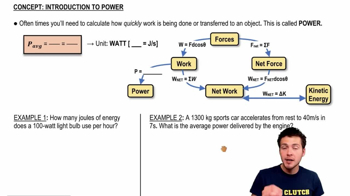
Power and Work

Power is the rate at which work is done or energy is transferred. In the context of vehicles, engine power is crucial for understanding how quickly a car can accelerate. The relationship between power, force, and velocity is given by the equation P = F * v, where P is power, F is force, and v is velocity. This concept helps in determining how much of the engine's power contributes to the car's acceleration.
Recommended video:

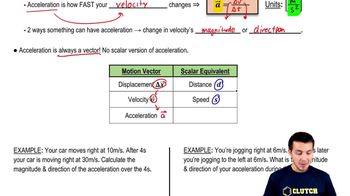
Acceleration

Acceleration is the rate of change of velocity of an object. In this scenario, the maximum acceleration (aₘₐₓ) can be calculated using Newton's second law, F = m * a, where F is the net force acting on the car, m is its mass, and a is acceleration. Understanding how acceleration relates to the forces acting on the car, including friction and engine power, is essential for solving the problem.
Recommended video:
Guided course
05:47
Intro to Acceleration

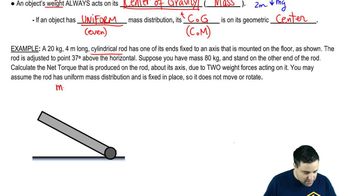
Weight Distribution

Weight distribution refers to how the weight of a vehicle is spread across its wheels. In this case, two-thirds of the car's weight is over the drive wheels, which affects traction and the maximum force that can be applied without slipping. This concept is important for calculating the effective normal force on the drive wheels, which influences the frictional force available for acceleration.
Recommended video:
Guided course
10:19
Torque Due to Weight
Related Practice
Textbook Question

Astronomers using a 2.0-m-diameter telescope observe a distant supernova - an exploding star. The telescope's detector records 9.1 x 10⁻¹¹ J of light energy during the first 10 s. It's known that this type of supernova has a visible-light power output of 5.0 x 1037 W for the first 10 s of the explosion. How distant is the supernova? Give your answer in light years, where one light year is the distance light travels in one year. The speed of light is 3.0 x 10⁸ m/s.

1
views
Textbook Question

When you ride a bicycle at constant speed, nearly all the energy you expend goes into the work you do against the drag force of the air. Model a cyclist as having cross-section area 0.45 m² and, because the human body is not aerodynamically shaped, a drag coefficient of 0.90. Use 1.2 kg/m³ as the density of air at room temperature. The food calorie is equivalent to 4190 J. How many calories does the cyclist burn if he rides over level ground at 7.3 m/s for 1 h?

2
views
Textbook Question

When you ride a bicycle at constant speed, nearly all the energy you expend goes into the work you do against the drag force of the air. Model a cyclist as having cross-section area 0.45 m² and, because the human body is not aerodynamically shaped, a drag coefficient of 0.90. Use 1.2 kg/m³ as the density of air at room temperature. Metabolic power is the rate at which your body 'burns' fuel to power your activities. For many activities, your body is roughly 25% efficient at converting the chemical energy of food into mechanical energy. What is the cyclist's metabolic power while cycling at 7.3 m/s?

2
views
Textbook Question

A Porsche 944 Turbo has a rated engine power of 217 hp. 30% of the power is lost in the engine and the drive train, and 70% reaches the wheels. The total mass of the car and driver is 1480 kg, and two-thirds of the weight is over the drive wheels. How long does it take the Porsche to reach the maximum power output?

2
views
Textbook Question

A farmer uses a tractor to pull a 150 kg bale of hay up a 15° incline to the barn at a steady 5.0 km/h. The coefficient of kinetic friction between the bale and the ramp is 0.45. What is the tractor's power output?

1
views
Textbook Question

A Porsche 944 Turbo has a rated engine power of 217 hp. 30% of the power is lost in the engine and the drive train, and 70% reaches the wheels. The total mass of the car and driver is 1480 kg, and two-thirds of the weight is over the drive wheels. What is the maximum acceleration of the Porsche on a concrete surface where μs = 1.00? Hint: What force pushes the car forward?

1
views