
Ch 09: Work and Kinetic Energy
Knight Calc - Physics for Scientists and Engineers 5th Edition
Knight Calc5th EditionPhysics for Scientists and EngineersISBN: 9780137344796Not the one you use?Change textbook
Chapter 9, Problem 70a

A 12 kg weather rocket generates a thrust of 200 N. The rocket, pointing upward, is clamped to the top of a vertical spring. The bottom of the spring, whose spring constant is 550 N/m, is anchored to the ground. Initially, before the engine is ignited, the rocket sits at rest on top of the spring. How much is the spring compressed?

Verified step by step guidance
1
Step 1: Begin by identifying the forces acting on the rocket when it is at rest on the spring. These forces are the gravitational force acting downward and the spring force acting upward. At equilibrium, these forces are equal in magnitude.
Step 2: Write the equation for the gravitational force acting on the rocket: \( F_{\text{gravity}} = m \cdot g \), where \( m = 12 \; \text{kg} \) is the mass of the rocket and \( g = 9.8 \; \text{m/s}^2 \) is the acceleration due to gravity.
Step 3: Write the equation for the spring force using Hooke's Law: \( F_{\text{spring}} = k \cdot x \), where \( k = 550 \; \text{N/m} \) is the spring constant and \( x \) is the compression of the spring.
Step 4: Set the gravitational force equal to the spring force at equilibrium: \( m \cdot g = k \cdot x \). Solve for \( x \) by rearranging the equation: \( x = \frac{m \cdot g}{k} \).
Step 5: Substitute the known values of \( m \), \( g \), and \( k \) into the equation to calculate \( x \), the compression of the spring. Ensure the units are consistent throughout the calculation.

Verified video answer for a similar problem:

This video solution was recommended by our tutors as helpful for the problem above.
Video duration:
4m
Was this helpful?

Key Concepts

Here are the essential concepts you must grasp in order to answer the question correctly.

Newton's Second Law of Motion

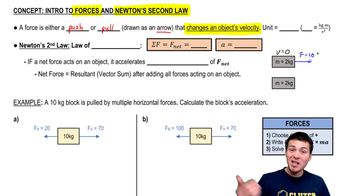
Newton's Second Law states that the force acting on an object is equal to the mass of that object multiplied by its acceleration (F = ma). In this scenario, the thrust generated by the rocket and the gravitational force acting on it must be balanced to determine the spring's compression when the rocket is at rest.
Recommended video:
Guided course
06:54
Intro to Forces & Newton's Second Law

Spring Force and Hooke's Law

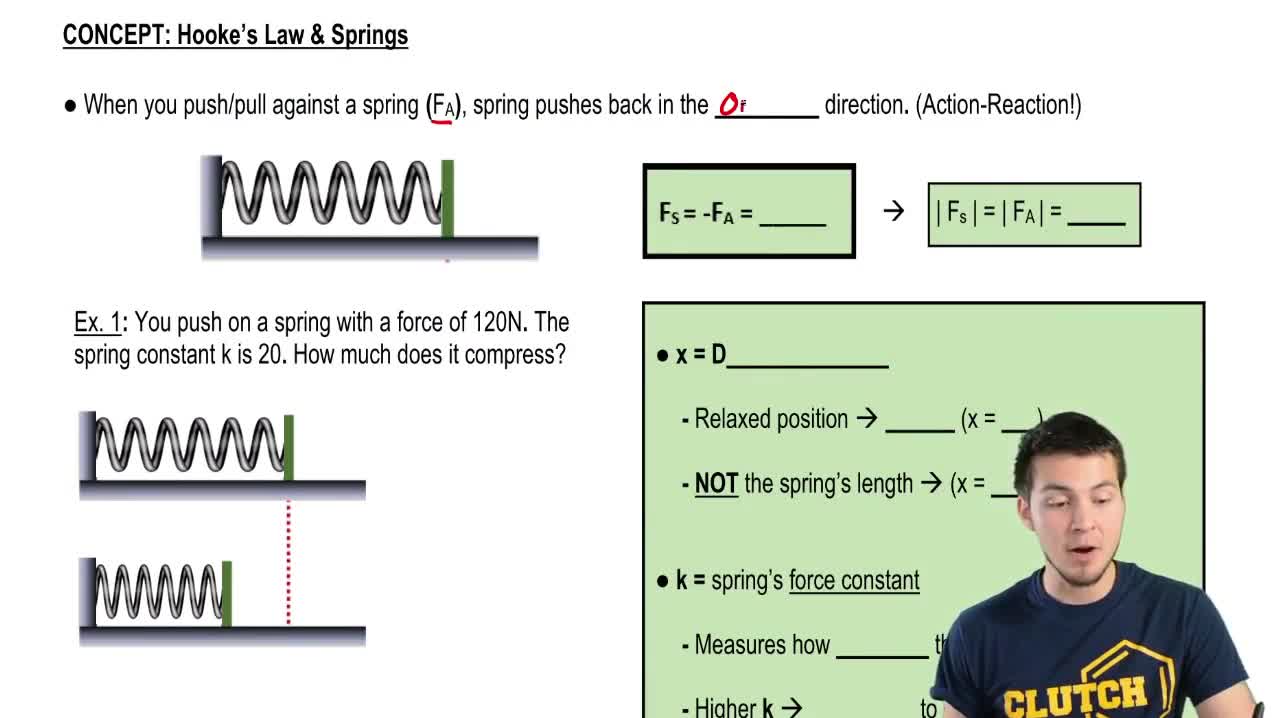
Hooke's Law describes the behavior of springs, stating that the force exerted by a spring is proportional to its displacement from the equilibrium position (F = -kx). Here, 'k' is the spring constant, and 'x' is the compression of the spring. This relationship is crucial for calculating how much the spring compresses under the weight of the rocket.
Recommended video:
Guided course
05:27
Spring Force (Hooke's Law)

Equilibrium Condition

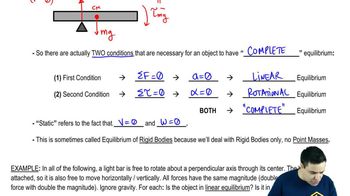
An object is in equilibrium when the net force acting on it is zero. In this case, the upward thrust from the rocket must equal the downward gravitational force and the spring force when the rocket is at rest. Understanding this condition allows us to set up the equation needed to find the spring's compression.
Recommended video:
Guided course
10:13
Torque & Equilibrium
Related Practice