Ch 09: Work and Kinetic Energy
Knight Calc - Physics for Scientists and Engineers 5th Edition
Knight Calc5th EditionPhysics for Scientists and EngineersISBN: 9780137344796Not the one you use?Change textbook
Chapter 9, Problem 34

Justin, with a mass of 30 kg, is going down an 8.0-m-high water slide. He starts at rest, and his speed at the bottom is 11 m/s. How much thermal energy is created by friction during his descent?

Verified step by step guidance
1
Step 1: Identify the energy transformations involved. Justin starts at rest, so his initial energy is purely gravitational potential energy. At the bottom of the slide, he has kinetic energy, and some energy is lost as thermal energy due to friction.
Step 2: Calculate Justin's initial gravitational potential energy using the formula: Eginitial=mgh, where m is his mass (30 kg), g is the acceleration due to gravity (9.8 m/s²), and h is the height of the slide (8.0 m).
Step 3: Calculate Justin's kinetic energy at the bottom of the slide using the formula: Ekfinal=12mv2, where m is his mass (30 kg) and v is his speed at the bottom (11 m/s).
Step 4: Determine the total energy lost to friction by subtracting the final kinetic energy from the initial gravitational potential energy. Use the formula: Ethermal=Eginitial-Ekfinal.
Step 5: Verify the units of your calculations to ensure consistency (e.g., joules for energy) and interpret the result as the amount of thermal energy generated by friction during Justin's descent.

Verified video answer for a similar problem:

This video solution was recommended by our tutors as helpful for the problem above.
Video duration:
9m
Was this helpful?

Key Concepts

Here are the essential concepts you must grasp in order to answer the question correctly.

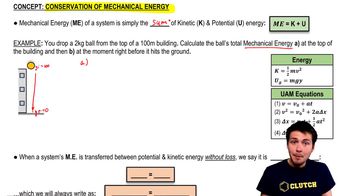
Conservation of Energy

The principle of conservation of energy states that energy cannot be created or destroyed, only transformed from one form to another. In this scenario, Justin's potential energy at the top of the slide is converted into kinetic energy as he descends. Any difference between the initial potential energy and the final kinetic energy indicates energy lost to friction, which manifests as thermal energy.
Recommended video:
Guided course
06:24
Conservation Of Mechanical Energy

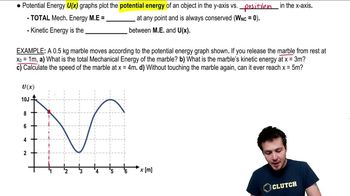
Potential Energy

Potential energy is the energy stored in an object due to its position in a gravitational field. For Justin, this is calculated using the formula PE = mgh, where m is mass, g is the acceleration due to gravity, and h is height. At the top of the slide, his potential energy is at its maximum, which decreases as he descends, converting into kinetic energy and thermal energy due to friction.
Recommended video:
Guided course
07:24
Potential Energy Graphs

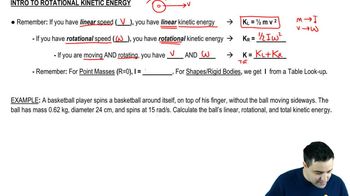
Kinetic Energy

Kinetic energy is the energy of an object in motion, defined by the formula KE = 0.5mv², where m is mass and v is velocity. At the bottom of the slide, Justin's kinetic energy reflects his speed. The difference between the initial potential energy and the final kinetic energy helps quantify the thermal energy generated by friction during his descent.
Recommended video:
Guided course
06:07
Intro to Rotational Kinetic Energy