Ch 09: Work and Kinetic Energy
Knight Calc - Physics for Scientists and Engineers 5th Edition
Knight Calc5th EditionPhysics for Scientists and EngineersISBN: 9780137344796Not the one you use?Change textbook
Chapter 9, Problem 33

A baggage handler throws a 15 kg suitcase along the floor of an airplane luggage compartment with a speed of 1.2 m/s. The suitcase slides 2.0 m before stopping. Use work and energy to find the suitcase's coefficient of kinetic friction on the floor.

Verified step by step guidance
1
Step 1: Identify the key concepts involved in the problem. This problem involves the work-energy principle and the relationship between frictional force and the coefficient of kinetic friction. The suitcase's initial kinetic energy is converted into work done against friction as it slides to a stop.
Step 2: Write the expression for the initial kinetic energy of the suitcase. The kinetic energy is given by \( KE = \frac{1}{2} m v^2 \), where \( m \) is the mass of the suitcase (15 kg) and \( v \) is its initial velocity (1.2 m/s).
Step 3: Relate the work done by friction to the kinetic energy. The work done by friction is \( W = F_{friction} \cdot d \), where \( F_{friction} = \mu_k \cdot m \cdot g \), \( \mu_k \) is the coefficient of kinetic friction, \( m \) is the mass, \( g \) is the acceleration due to gravity (9.8 m/s²), and \( d \) is the distance the suitcase slides (2.0 m).
Step 4: Set the work done by friction equal to the initial kinetic energy. Using the work-energy principle, \( \frac{1}{2} m v^2 = \mu_k \cdot m \cdot g \cdot d \). Notice that the mass \( m \) cancels out from both sides of the equation.
Step 5: Solve for \( \mu_k \), the coefficient of kinetic friction. Rearrange the equation to isolate \( \mu_k \): \( \mu_k = \frac{\frac{1}{2} v^2}{g \cdot d} \). Substitute the known values for \( v \), \( g \), and \( d \) to calculate \( \mu_k \).

Verified video answer for a similar problem:

This video solution was recommended by our tutors as helpful for the problem above.
Video duration:
8m
Was this helpful?

Key Concepts

Here are the essential concepts you must grasp in order to answer the question correctly.

Work-Energy Principle

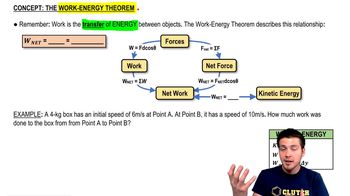
The Work-Energy Principle states that the work done on an object is equal to the change in its kinetic energy. In this scenario, the suitcase starts with a certain kinetic energy due to its speed and comes to a stop, meaning its final kinetic energy is zero. The work done by friction is what causes this change in energy, allowing us to relate the distance slid to the force of friction.
Recommended video:
Guided course
04:10
The Work-Energy Theorem

Kinetic Friction

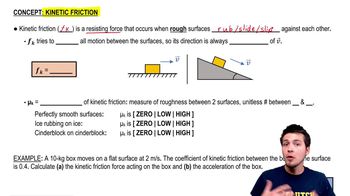
Kinetic friction is the force that opposes the motion of two surfaces sliding past each other. It is proportional to the normal force and is characterized by the coefficient of kinetic friction (μk). This coefficient quantifies how much frictional force acts on the suitcase as it slides, and it can be calculated using the relationship between the frictional force, the normal force, and the acceleration due to friction.
Recommended video:
Guided course
06:18
Kinetic Friction Problems

Frictional Force and Normal Force

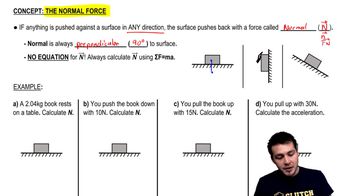
The frictional force acting on an object is given by the equation F_friction = μk * N, where N is the normal force. For a suitcase on a flat surface, the normal force equals the weight of the suitcase (mass times gravitational acceleration). Understanding this relationship is crucial for calculating the coefficient of kinetic friction, as it directly influences the deceleration of the suitcase as it slides to a stop.
Recommended video:
Guided course
08:17
The Normal Force