Ch 09: Work and Kinetic Energy
Knight Calc - Physics for Scientists and Engineers 5th Edition
Knight Calc5th EditionPhysics for Scientists and EngineersISBN: 9780137344796Not the one you use?Change textbook
Chapter 9, Problem 35b

An 8.0 kg crate is pulled 5.0 m up a 30° incline by a rope angled 18 ° above the incline. The tension in the rope is 120 N, and the crate's coefficient of kinetic friction on the incline is 0.25. What is the increase in thermal energy of the crate and incline?

Verified step by step guidance
1
Step 1: Understand the problem. The increase in thermal energy is due to the work done against friction as the crate moves up the incline. Frictional force depends on the normal force and the coefficient of kinetic friction. Begin by calculating the normal force acting on the crate.
Step 2: Calculate the normal force. The normal force is the component of the crate's weight perpendicular to the incline. Use the formula: \( F_{\text{normal}} = m g \cos \theta \), where \( m \) is the mass of the crate, \( g \) is the acceleration due to gravity (9.8 m/s²), and \( \theta \) is the angle of the incline (30°).
Step 3: Determine the frictional force. The frictional force is given by \( F_{\text{friction}} = \mu F_{\text{normal}} \), where \( \mu \) is the coefficient of kinetic friction (0.25) and \( F_{\text{normal}} \) is the normal force calculated in Step 2.
Step 4: Calculate the work done against friction. Work is the product of force and displacement in the direction of the force. Use the formula: \( W_{\text{friction}} = F_{\text{friction}} \cdot d \), where \( d \) is the displacement of the crate along the incline (5.0 m).
Step 5: The increase in thermal energy is equal to the work done against friction. This is because the energy lost due to friction is converted into thermal energy. Use the value of \( W_{\text{friction}} \) from Step 4 to find the increase in thermal energy.

Verified video answer for a similar problem:

This video solution was recommended by our tutors as helpful for the problem above.
Video duration:
7m
Was this helpful?

Key Concepts

Here are the essential concepts you must grasp in order to answer the question correctly.

Friction and Thermal Energy

Friction is the force that opposes the relative motion of two surfaces in contact. When an object moves against a surface, kinetic friction converts some of the object's mechanical energy into thermal energy, increasing the temperature of both the object and the surface. The coefficient of kinetic friction quantifies this interaction, indicating how much frictional force acts relative to the normal force.
Recommended video:
Guided course
05:21
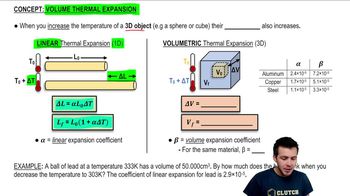
Volume Thermal Expansion

Work-Energy Principle

The work-energy principle states that the work done on an object is equal to the change in its kinetic energy. In this scenario, the work done by the tension in the rope and the work done against friction must be considered to determine the increase in thermal energy. The net work done on the crate will result in a change in energy, which can be calculated to find the thermal energy increase.
Recommended video:
Guided course
04:10
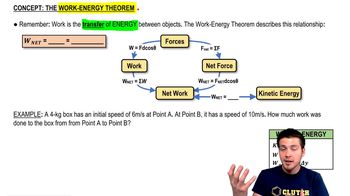
The Work-Energy Theorem

Inclined Plane Dynamics

An inclined plane is a flat surface tilted at an angle to the horizontal, affecting the forces acting on an object resting on it. The gravitational force acting on the crate can be resolved into components parallel and perpendicular to the incline. Understanding these forces, including the tension in the rope and frictional forces, is essential for analyzing the motion and energy transformations of the crate as it moves up the incline.
Recommended video:
Guided course
06:59
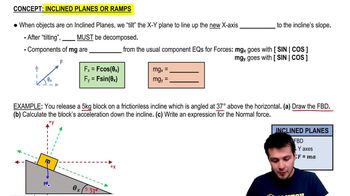
Intro to Inclined Planes