Ch 08: Dynamics II: Motion in a Plane
Knight Calc - Physics for Scientists and Engineers 5th Edition
Knight Calc5th EditionPhysics for Scientists and EngineersISBN: 9780137344796Not the one you use?Change textbook
Chapter 8, Problem 45a

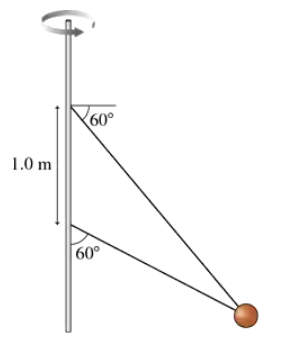
Two wires are tied to the 2.0 kg sphere shown in FIGURE P8.45. The sphere revolves in a horizontal circle at constant speed. For what speed is the tension the same in both wires?

Verified step by step guidance
1
Analyze the forces acting on the sphere: The sphere is in uniform circular motion, so the forces acting on it are the tension in the two wires and the gravitational force. The tension in the wires provides the centripetal force required for circular motion, while the gravitational force acts vertically downward.
Break the forces into components: Let the tensions in the two wires be T₁ and T₂. Since the problem states that the tensions are equal (T₁ = T₂), we can simplify the analysis. Resolve the tension forces into horizontal and vertical components. The horizontal components of the tensions provide the centripetal force, and the vertical components balance the gravitational force.
Set up the vertical force balance: The vertical components of the tensions must balance the weight of the sphere. Using trigonometry, if the angle each wire makes with the vertical is θ, the vertical component of the tension is T * cos(θ). Therefore, 2 * T * cos(θ) = m * g, where m is the mass of the sphere and g is the acceleration due to gravity.
Set up the horizontal force balance: The horizontal components of the tensions provide the centripetal force. Using trigonometry, the horizontal component of the tension is T * sin(θ). Therefore, the total centripetal force is 2 * T * sin(θ), and this equals m * v² / r, where v is the speed of the sphere and r is the radius of the circular path.
Combine the equations: Use the vertical force balance equation to solve for T in terms of m, g, and θ. Substitute this expression for T into the horizontal force balance equation. This will allow you to solve for the speed v in terms of m, g, θ, and r. Simplify the resulting equation to find the speed at which the tensions are equal.

Verified video answer for a similar problem:

This video solution was recommended by our tutors as helpful for the problem above.
Video duration:
11m
Was this helpful?

Key Concepts

Here are the essential concepts you must grasp in order to answer the question correctly.

Centripetal Force

Centripetal force is the net force acting on an object moving in a circular path, directed towards the center of the circle. For an object to maintain circular motion, this force must be continuously applied, counteracting the object's inertia. In the context of the sphere, the tension in the wires provides the necessary centripetal force to keep it moving in a horizontal circle.
Recommended video:
Guided course
06:48
Intro to Centripetal Forces

Tension in Wires

Tension is the force transmitted through a string, rope, or wire when it is pulled tight by forces acting from opposite ends. In this scenario, the tension in both wires must be equal when the sphere revolves at a constant speed, ensuring that the net force acting on the sphere is balanced. Understanding how tension varies with the angle and length of the wires is crucial for solving the problem.
Recommended video:
Guided course
09:57
Magnetic Force on Current-Carrying Wire

Uniform Circular Motion

Uniform circular motion refers to the motion of an object traveling in a circular path at a constant speed. Although the speed remains constant, the direction of the object's velocity changes continuously, resulting in an acceleration directed towards the center of the circle. This concept is essential for analyzing the forces acting on the sphere and determining the conditions under which the tensions in the wires are equal.
Recommended video:
Guided course
03:48
Intro to Circular Motion
Related Practice
Textbook Question

A concrete highway curve of radius 70 m is banked at a 15° angle. What is the maximum speed with which a 1500 kg rubber-tired car can take this curve without sliding?

Textbook Question

A 2.0 kg pendulum bob swings on a 2.0-m-long string. The bob's speed is 1.5 m/s when the string makes a 15° angle with vertical and the bob is moving toward the bottom of the arc. At this instant, what are the magnitudes of the tension in the string?

Textbook Question

In an amusement park ride called The Roundup, passengers stand inside a 16-m-diameter rotating ring. After the ring has acquired sufficient speed, it tilts into a vertical plane, as shown in FIGURE P8.51. What is the longest rotation period of the wheel that will prevent the riders from falling off at the top?

1
views
Textbook Question

A 4.4-cm-diameter, 24 g plastic ball is attached to a 1.2-m-long string and swung in a vertical circle. The ball's speed is 6.1 m/s at the point where it is moving straight up. What is the magnitude of the net force on the ball? Air resistance is not negligible.

Textbook Question

A conical pendulum is formed by attaching a ball of mass m to a string of length L, then allowing the ball to move in a horizontal circle of radius r. FIGURE P8.48 shows that the string traces out the surface of a cone, hence the name. Find an expression for the ball's angular speed ω.

1
views
Textbook Question

An object of mass m swings in a horizontal circle on a string of length L that tilts downward at angle θ. Find an expression for the angular velocity ω.