
Ch 08: Dynamics II: Motion in a Plane
Knight Calc - Physics for Scientists and Engineers 5th Edition
Knight Calc5th EditionPhysics for Scientists and EngineersISBN: 9780137344796Not the one you use?Change textbook
Chapter 8, Problem 48b

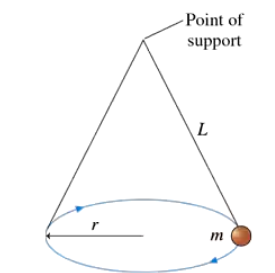
A conical pendulum is formed by attaching a ball of mass m to a string of length L, then allowing the ball to move in a horizontal circle of radius r. FIGURE P8.48 shows that the string traces out the surface of a cone, hence the name. Find an expression for the ball's angular speed ω.

Verified step by step guidance
1
Step 1: Analyze the forces acting on the ball. The forces are the tension in the string (T) and the gravitational force (mg). The tension can be resolved into two components: a vertical component (Tcosθ) that balances the gravitational force and a horizontal component (Tsinθ) that provides the centripetal force for circular motion.
Step 2: Relate the geometry of the conical pendulum to the angle θ. From the diagram, the radius of the circular motion is r, and the length of the string is L. Using trigonometry, we can write sinθ = r/L and cosθ = √(1 - (r/L)^2).
Step 3: Write the force balance equations. Vertically, Tcosθ = mg. Horizontally, Tsinθ = mω²r, where ω is the angular speed we need to find.
Step 4: Solve for T using the vertical force equation. From Tcosθ = mg, we get T = mg/cosθ. Substitute this expression for T into the horizontal force equation.
Step 5: Substitute T = mg/cosθ into Tsinθ = mω²r. Simplify the equation to express ω in terms of m, g, r, and L. Use the trigonometric relationships sinθ = r/L and cosθ = √(1 - (r/L)^2) to eliminate θ and obtain the final expression for ω.

Verified video answer for a similar problem:

This video solution was recommended by our tutors as helpful for the problem above.
Was this helpful?

Key Concepts

Here are the essential concepts you must grasp in order to answer the question correctly.

Conical Pendulum

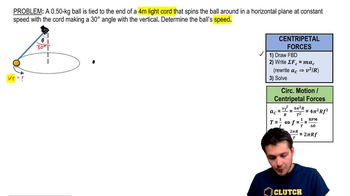
A conical pendulum consists of a mass attached to a string that moves in a horizontal circular path while the string traces out a cone. The motion involves both vertical and horizontal components, with the tension in the string providing the necessary centripetal force to keep the mass moving in a circle. Understanding this setup is crucial for analyzing the forces acting on the mass and deriving the expression for angular speed.
Recommended video:
Guided course
05:22
Conical Pendulum

Centripetal Force

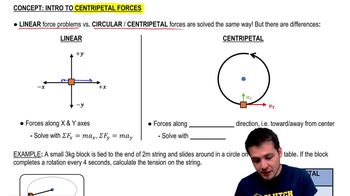
Centripetal force is the net force directed towards the center of a circular path that keeps an object moving in that path. In the case of a conical pendulum, this force is provided by the horizontal component of the tension in the string. The relationship between centripetal force, mass, radius, and angular speed is essential for deriving the angular speed of the pendulum.
Recommended video:
Guided course
06:48
Intro to Centripetal Forces

Angular Speed (ω)

Angular speed, denoted as ω, is a measure of how quickly an object rotates around a central point, expressed in radians per second. For a conical pendulum, angular speed can be derived from the relationship between linear speed and the radius of the circular path. Understanding how to relate linear and angular quantities is key to solving for ω in this scenario.
Recommended video:
Guided course
07:59
Speed Distribution & Special Speeds of Ideal Gases
Related Practice
Textbook Question

A 2.0 kg pendulum bob swings on a 2.0-m-long string. The bob's speed is 1.5 m/s when the string makes a 15° angle with vertical and the bob is moving toward the bottom of the arc. At this instant, what are the magnitudes of the tension in the string?

Textbook Question

Two wires are tied to the 2.0 kg sphere shown in FIGURE P8.45. The sphere revolves in a horizontal circle at constant speed. For what speed is the tension the same in both wires?

Textbook Question

In an amusement park ride called The Roundup, passengers stand inside a 16-m-diameter rotating ring. After the ring has acquired sufficient speed, it tilts into a vertical plane, as shown in FIGURE P8.51. What is the longest rotation period of the wheel that will prevent the riders from falling off at the top?

1
views
Textbook Question

A 4.4-cm-diameter, 24 g plastic ball is attached to a 1.2-m-long string and swung in a vertical circle. The ball's speed is 6.1 m/s at the point where it is moving straight up. What is the magnitude of the net force on the ball? Air resistance is not negligible.

Textbook Question

A 30 g ball rolls around a 40-cm-diameter L-shaped track, shown in FIGURE P8.53, at 60 rpm. What is the magnitude of the net force that the track exerts on the ball? Rolling friction can be neglected. Hint: The track exerts more than one force on the ball.

1
views
Textbook Question

Suppose you swing a ball of mass m in a vertical circle on a string of length L. As you probably know from experience, there is a minimum angular velocity ωmin you must maintain if you want the ball to complete the full circle without the string going slack at the top. Find an expression for ωmin.