
An airplane feels a lift force perpendicular to its wings. In level flight, the lift force points straight up and is equal in magnitude to the gravitational force on the plane. When an airplane turns, it banks by tilting its wings, as seen from behind, by an angle from horizontal. This causes the lift to have a radial component, similar to a car on a banked curve. If the lift had constant magnitude, the vertical component of would now be smaller than the gravitational force, and the plane would lose altitude while turning. However, you can assume that the pilot uses small adjustments to the plane's control surfaces so that the vertical component of continues to balance the gravitational force throughout the turn. Find an expression for the banking angle needed to turn in a circle of radius while flying at constant speed .

- Ch 01: Concepts of Motion35
- Ch 02: Kinematics in One Dimension75
- Ch 03: Vectors and Coordinate Systems58
- Ch 04: Kinematics in Two Dimensions60
- Ch 05: Force and Motion23
- Ch 06: Dynamics I: Motion Along a Line53
- Ch 07: Newton's Third Law27
- Ch 08: Dynamics II: Motion in a Plane52
- Ch 09: Work and Kinetic Energy56
- Ch 10: Interactions and Potential Energy50
- Ch 11: Impulse and Momentum56
- Ch 12: Rotation of a Rigid Body71
- Ch 13: Newton's Theory of Gravity52
- Ch 14: Fluids and Elasticity44
- Ch 15: Oscillations55
- Ch 16: Traveling Waves37
- Ch 17: Superposition39
- Ch 18: A Macroscopic Description of Matter53
- Ch 19: Work, Heat, and the First Law of Thermodynamics60
- Ch 20: The Micro/Macro Connection53
- Ch 21: Heat Engines and Refrigerators34
- Ch 22: Electric Charges and Forces40
- Ch 23: The Electric Field39
- Ch 24: Gauss' Law32
- Ch 25: The Electric Potential63
- Ch 26: Potential and Field57
- Ch 27: Current and Resistance42
- Ch 28: Fundamentals of Circuits39
- Ch 29: The Magnetic Field47
- Ch 30: Electromagnetic Induction60
- Ch 31: Electromagnetic Fields and Waves32
- Ch 32: AC Circuits63
- Ch 33: Wave Optics32
- Ch 34: Ray Optics57
- Ch 35: Optical Instruments30
- Ch 36: Special Relativity38
- Ch 37: The Foundations of Modern Physics25
- Ch 38: Quantization49
- Ch 39: Wave Functions and Uncertainty31
- Ch 40: One-Dimensional Quantum Mechanics35
- Ch 41: Atomic Physics18
- Ch 42: Nuclear Physics27
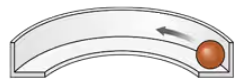
A 30 g ball rolls around a 40-cm-diameter L-shaped track, shown in FIGURE P8.53, at 60 rpm. What is the magnitude of the net force that the track exerts on the ball? Rolling friction can be neglected. Hint: The track exerts more than one force on the ball.
 Verified step by step guidance
Verified video answer for a similar problem:

Key Concepts
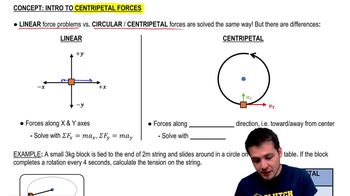
Centripetal Force
 06:48
06:48
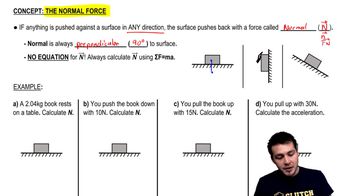
Normal Force
 08:17
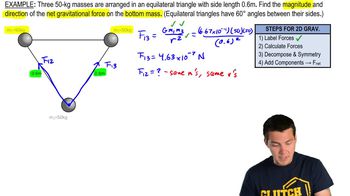
08:17Net Force
 06:28
06:28The physics of circular motion sets an upper limit to the speed of human walking. (If you need to go faster, your gait changes from a walk to a run.) If you take a few steps and watch what's happening, you'll see that your body pivots in circular motion over your forward foot as you bring your rear foot forward for the next step. As you do so, the normal force of the ground on your foot decreases and your body tries to 'lift off' from the ground. A person's center of mass is very near the hips, at the top of the legs. Model a person as a particle of mass m at the top of a leg of length L. Find an expression for the person's maximum walking speed vmax.
In an amusement park ride called The Roundup, passengers stand inside a 16-m-diameter rotating ring. After the ring has acquired sufficient speed, it tilts into a vertical plane, as shown in FIGURE P8.51. What is the longest rotation period of the wheel that will prevent the riders from falling off at the top?
A conical pendulum is formed by attaching a ball of mass m to a string of length L, then allowing the ball to move in a horizontal circle of radius r. FIGURE P8.48 shows that the string traces out the surface of a cone, hence the name. Find an expression for the ball's angular speed ω.
Suppose you swing a ball of mass m in a vertical circle on a string of length L. As you probably know from experience, there is a minimum angular velocity ωmin you must maintain if you want the ball to complete the full circle without the string going slack at the top. Find an expression for ωmin.
FIGURE P8.54 shows two small 1.0 kg masses connected by massless but rigid 1.0-m-long rods. What is the tension in the rod that connects to the pivot if the masses rotate at 30 rpm in a horizontal circle?