
Ch 08: Dynamics II: Motion in a Plane
Knight Calc - Physics for Scientists and Engineers 5th Edition
Knight Calc5th EditionPhysics for Scientists and EngineersISBN: 9780137344796Not the one you use?Change textbook
Chapter 8, Problem 41

A concrete highway curve of radius 70 m is banked at a 15° angle. What is the maximum speed with which a 1500 kg rubber-tired car can take this curve without sliding?

Verified step by step guidance
1
Identify the forces acting on the car: the gravitational force \( F_g = m g \), the normal force \( F_N \), and the frictional force \( F_f \). The car is moving in a circular path, so there is also a centripetal force \( F_c \) directed toward the center of the curve.
Break the forces into components. The normal force \( F_N \) has a vertical component \( F_N \cos(\theta) \) and a horizontal component \( F_N \sin(\theta) \). The frictional force \( F_f \) also has components: \( F_f \cos(\theta) \) (horizontal) and \( F_f \sin(\theta) \) (vertical).
Write the equations for vertical and horizontal force balance. Vertically, the sum of forces is zero: \( F_N \cos(\theta) + F_f \sin(\theta) = m g \). Horizontally, the net force provides the centripetal force: \( F_N \sin(\theta) + F_f \cos(\theta) = \frac{m v^2}{r} \).
Express the maximum frictional force as \( F_f = \mu F_N \), where \( \mu \) is the coefficient of static friction. Substitute this into the equations for vertical and horizontal force balance.
Solve the system of equations to find the maximum speed \( v \). Use the given values: \( r = 70 \ \text{m} \), \( \theta = 15^\circ \), \( m = 1500 \ \text{kg} \), and \( g = 9.8 \ \text{m/s}^2 \). The coefficient of friction \( \mu \) is not provided, so assume it is sufficient to prevent sliding.

Verified video answer for a similar problem:

This video solution was recommended by our tutors as helpful for the problem above.
Was this helpful?

Key Concepts

Here are the essential concepts you must grasp in order to answer the question correctly.

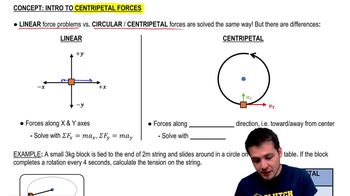
Centripetal Force

Centripetal force is the net force required to keep an object moving in a circular path, directed towards the center of the circle. For a car navigating a banked curve, this force is provided by the combination of gravitational force and the normal force acting on the car. The formula for centripetal force is F_c = mv^2/r, where m is mass, v is velocity, and r is the radius of the curve.
Recommended video:
Guided course
06:48
Intro to Centripetal Forces

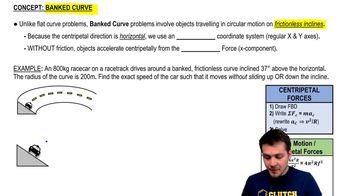
Banking Angle

The banking angle of a curve is the angle at which the road is inclined relative to the horizontal. This angle helps reduce the reliance on friction to maintain circular motion. The optimal banking angle can be calculated using the formula θ = tan^(-1)(v^2/(rg)), where v is the speed of the vehicle, r is the radius of the curve, and g is the acceleration due to gravity.
Recommended video:

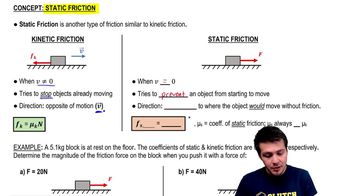
Frictional Force

Frictional force is the resistance that one surface or object encounters when moving over another. In the context of a car on a banked curve, friction can either assist in providing the necessary centripetal force or oppose it. The maximum static frictional force can be calculated using F_friction = μN, where μ is the coefficient of friction and N is the normal force, which is affected by the banking angle.
Recommended video:
Guided course
08:11
Static Friction & Equilibrium