Ch 08: Dynamics II: Motion in a Plane
Knight Calc - Physics for Scientists and Engineers 5th Edition
Knight Calc5th EditionPhysics for Scientists and EngineersISBN: 9780137344796Not the one you use?Change textbook
Chapter 8, Problem 39

A 75 kg man weighs himself at the north pole and at the equator. Which scale reading is higher? By how much? Assume the earth is spherical.

Verified step by step guidance
1
Step 1: Understand the problem. The man weighs himself at two locations: the north pole and the equator. The scale reading measures the normal force exerted by the ground on the man, which is affected by gravitational force and centripetal force due to Earth's rotation. We need to determine which reading is higher and by how much.
Step 2: Analyze the forces acting on the man. At the north pole, the gravitational force is the only force acting on him since there is no rotational motion. At the equator, the gravitational force is reduced by the centripetal force due to Earth's rotation. The centripetal force is given by \( F_c = m \cdot \omega^2 \cdot r \), where \( m \) is the mass of the man, \( \omega \) is the angular velocity of Earth, and \( r \) is the radius of Earth.
Step 3: Calculate the gravitational force at both locations. The gravitational force is given by \( F_g = m \cdot g \), where \( g \) is the acceleration due to gravity. At the north pole, \( g \) is unaffected by rotation, while at the equator, \( g \) is slightly reduced due to the centripetal force.
Step 4: Determine the scale reading at each location. At the north pole, the scale reading equals the gravitational force \( F_g \). At the equator, the scale reading equals \( F_g - F_c \), where \( F_c \) is the centripetal force. Subtract the centripetal force from the gravitational force to find the scale reading at the equator.
Step 5: Compare the scale readings. The reading at the north pole will be higher because the centripetal force reduces the effective weight at the equator. To find the difference, subtract the scale reading at the equator from the scale reading at the north pole.

Verified video answer for a similar problem:

This video solution was recommended by our tutors as helpful for the problem above.
Was this helpful?

Key Concepts

Here are the essential concepts you must grasp in order to answer the question correctly.

Weight and Gravitational Force

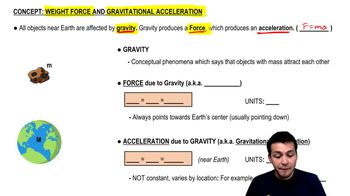
Weight is the force exerted on an object due to gravity, calculated as the product of mass and gravitational acceleration (W = mg). The gravitational force varies slightly depending on location due to the Earth's shape and rotation, affecting scale readings.
Recommended video:
Guided course
07:32
Weight Force & Gravitational Acceleration

Centrifugal Force

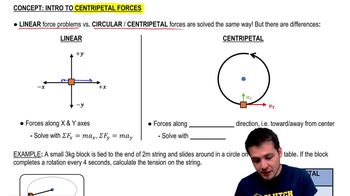
Centrifugal force is an apparent force that acts outward on a mass moving in a circular path, resulting from the rotation of the Earth. At the equator, this force counteracts gravitational pull slightly more than at the poles, leading to a lower weight reading on a scale.
Recommended video:
Guided course
06:48
Intro to Centripetal Forces

Variation in Gravitational Acceleration

Gravitational acceleration varies with latitude due to the Earth's rotation and its equatorial bulge. At the poles, gravitational acceleration is approximately 9.83 m/s², while at the equator, it is about 9.78 m/s², causing a difference in weight measurements between these two locations.
Recommended video:
Guided course
07:32
Weight Force & Gravitational Acceleration
Related Practice
Textbook Question

A concrete highway curve of radius 70 m is banked at a 15° angle. What is the maximum speed with which a 1500 kg rubber-tired car can take this curve without sliding?

Textbook Question

A 4.4-cm-diameter, 24 g plastic ball is attached to a 1.2-m-long string and swung in a vertical circle. The ball's speed is 6.1 m/s at the point where it is moving straight up. What is the magnitude of the net force on the ball? Air resistance is not negligible.

Textbook Question

A 2.0 kg projectile with initial velocity v = 8.0 î m/s experiences the variable force F = -2.0t î + 4.0t² ĵ N, where t is in s. What is the projectile's speed at t = 2.0 s?

2
views
Textbook Question

A car can just barely turn a corner on an unbanked road at 45 km/h on a dry sunny day. What is the car's maximum cornering speed on a rainy day when the coefficient of static friction has been reduced by 50%?

2
views
Textbook Question

A motorcycle daredevil plans to ride up a 2.0-m-high, 20° ramp, sail across a 10-m-wide pool filled with hungry crocodiles, and land at ground level on the other side. He has done this stunt many times and approaches it with confidence. Unfortunately, the motorcycle engine dies just as he starts up the ramp. He is going 11 m/s at that instant, and the rolling friction of his rubber tires (coefficient 0.02) is not negligible. Does he survive, or does he become crocodile food? Justify your answer by calculating the distance he travels through the air after leaving the end of the ramp.

1
views
Textbook Question

An object of mass m swings in a horizontal circle on a string of length L that tilts downward at angle θ. Find an expression for the angular velocity ω.