
A 500 g steel block rotates on a steel table while attached to a 1.2-m-long hollow tube as shown in FIGURE CP8.70. Compressed air fed through the tube and ejected from a nozzle on the back of the block exerts a thrust force of 4.0 N perpendicular to the tube. The maximum tension the tube can withstand without breaking is 50 N. If the block starts from rest, how many revolutions does it make before the tube breaks?
Ch 08: Dynamics II: Motion in a Plane
Knight Calc5th EditionPhysics for Scientists and EngineersISBN: 9780137344796Not the one you use?Change textbook
Chapter 8, Problem 72
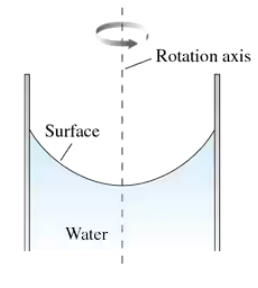
If a vertical cylinder of water (or any other liquid) rotates about its axis, as shown in FIGURE CP8.72, the surface forms a smooth curve. Assuming that the water rotates as a unit (i.e., all the water rotates with the same angular velocity), show that the shape of the surface is a parabola described by the equation z = (ω2 / 2g) r2. Hint: Each particle of water on the surface is subject to only two forces: gravity and the normal force due to the water underneath it. The normal force, as always, acts perpendicular to the surface.

Verified step by step guidance1
Start by analyzing the forces acting on a small particle of water on the surface. The forces are: (1) the gravitational force, which acts vertically downward with magnitude F_g = m * g, and (2) the normal force, which acts perpendicular to the surface of the water.
Recognize that the particle is in circular motion due to the rotation of the cylinder. This means there must be a net centripetal force directed toward the axis of rotation. The horizontal component of the normal force provides this centripetal force, F_c = m * ω^2 * r, where ω is the angular velocity and r is the radial distance from the axis.
Decompose the normal force into two components: (1) a vertical component that balances the gravitational force, and (2) a horizontal component that provides the centripetal force. Let the angle between the normal force and the vertical direction be θ. Then, N * cos(θ) = m * g (vertical balance) and N * sin(θ) = m * ω^2 * r (horizontal balance).
From the geometry of the surface, the slope of the surface at any point is given by tan(θ) = dz/dr, where z is the height of the surface and r is the radial distance. Using the trigonometric identity tan(θ) = sin(θ) / cos(θ), substitute the expressions for sin(θ) and cos(θ) from the force balance equations: tan(θ) = (m * ω^2 * r) / (m * g) = (ω^2 * r) / g.
Integrate the slope equation dz/dr = (ω^2 * r) / g to find the shape of the surface. The integral is z = ∫(ω^2 * r / g) dr = (ω^2 / 2g) * r^2 + C, where C is the constant of integration. Assuming the surface passes through the origin (z = 0 when r = 0), C = 0. Thus, the equation of the surface is z = (ω^2 / 2g) * r^2.

Verified video answer for a similar problem:
This video solution was recommended by our tutors as helpful for the problem above.
Video duration:
17mWas this helpful?
Key Concepts
Here are the essential concepts you must grasp in order to answer the question correctly.
Centripetal Force
Centripetal force is the net force that acts on an object moving in a circular path, directed towards the center of the circle. In the context of the rotating cylinder, this force is necessary to keep the water particles moving in a circular motion. It is provided by the normal force acting on the water surface, which counteracts the gravitational force pulling the particles downward.
Recommended video:
Guided course
Intro to Centripetal Forces
Hydrostatic Pressure
Hydrostatic pressure is the pressure exerted by a fluid at equilibrium due to the force of gravity. In a rotating cylinder, the pressure varies with depth and radial distance from the axis of rotation. This variation is crucial for understanding how the normal force changes across the surface of the water, influencing the shape of the surface as it rotates.
Recommended video:
Guided course
Pressure and Atmospheric Pressure
Parabolic Shape of the Surface
The parabolic shape of the water surface in a rotating cylinder arises from the balance of forces acting on the water particles. The equation z = (ω^2 / 2g) r^2 describes this relationship, where z is the height of the surface, ω is the angular velocity, g is the acceleration due to gravity, and r is the radial distance from the axis. This shape results from the interplay between gravitational force and the centripetal force required for circular motion.
Recommended video:
Guided course
Equipotential Surfaces
Related Practice
Textbook Question
1
views
Textbook Question
The 10 mg bead in FIGURE CP8.69 is free to slide on a frictionless wire loop. The loop rotates about a vertical axis with angular velocity ω. If ω is less than some critical value ω꜀, the bead sits at the bottom of the spinning loop. When ω > ω꜀, the bead moves out to some angle θ. What is ω꜀ in rpm for the loop shown in the figure?
Textbook Question
In the absence of air resistance, a projectile that lands at the elevation from which it was launched achieves maximum range when launched at a 45° angle. Suppose a projectile of mass m is launched with speed into a headwind that exerts a constant, horizontal retarding force By what percentage is the maximum range of a 0.50 kg ball reduced if ?
1
views
