
Ch 08: Dynamics II: Motion in a Plane
Knight Calc - Physics for Scientists and Engineers 5th Edition
Knight Calc5th EditionPhysics for Scientists and EngineersISBN: 9780137344796Not the one you use?Change textbook
Chapter 8, Problem 1

As a science fair project, you want to launch an 800 g model rocket straight up and hit a horizontally moving target as it passes 30 m above the launch point. The rocket engine provides a constant thrust of 15.0 N. The target is approaching at a speed of 15 m/s. At what horizontal distance between the target and the rocket should you launch?

Verified step by step guidance
1
Convert the mass of the rocket from grams to kilograms: \( m = 800 \, \text{g} = 0.8 \, \text{kg} \).
Calculate the net force acting on the rocket using \( F_{\text{net}} = F_{\text{thrust}} - F_{\text{gravity}} \), where \( F_{\text{gravity}} = m \cdot g \) and \( g = 9.8 \, \text{m/s}^2 \).
Determine the rocket's acceleration using Newton's second law: \( a = \frac{F_{\text{net}}}{m} \).
Use the kinematic equation \( h = \frac{1}{2} a t^2 \) to solve for the time \( t \) it takes for the rocket to reach the height of 30 m. Rearrange the equation to \( t = \sqrt{\frac{2h}{a}} \).
Calculate the horizontal distance the target travels during the time \( t \) using \( d = v \cdot t \), where \( v = 15 \, \text{m/s} \). This distance is the horizontal separation at which the rocket should be launched.

Verified video answer for a similar problem:

This video solution was recommended by our tutors as helpful for the problem above.
Video duration:
10m
Was this helpful?

Key Concepts

Here are the essential concepts you must grasp in order to answer the question correctly.

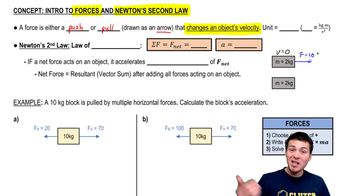
Newton's Second Law of Motion

Newton's Second Law states that the acceleration of an object is directly proportional to the net force acting on it and inversely proportional to its mass. This principle is crucial for understanding how the rocket will accelerate upwards under the influence of the thrust provided by its engine, allowing us to calculate its motion over time.
Recommended video:
Guided course
06:54
Intro to Forces & Newton's Second Law

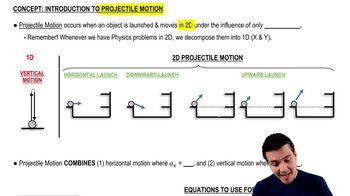
Projectile Motion

Projectile motion refers to the motion of an object that is launched into the air and is subject to gravitational force. In this scenario, the rocket's vertical motion can be analyzed as a projectile, allowing us to determine how long it will take to reach the target's height of 30 m, which is essential for calculating the horizontal distance needed for the launch.
Recommended video:
Guided course
04:44
Introduction to Projectile Motion

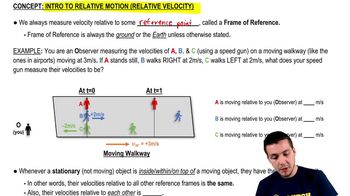
Relative Velocity

Relative velocity is the velocity of an object as observed from another moving object. In this problem, understanding the relative velocity between the rocket and the target is key to determining the correct launch distance, as the target is moving horizontally while the rocket ascends vertically, necessitating a calculation of their positions over time.
Recommended video:
Guided course
04:27
Intro to Relative Motion (Relative Velocity)