Ch 08: Dynamics II: Motion in a Plane
Knight Calc - Physics for Scientists and Engineers 5th Edition
Knight Calc5th EditionPhysics for Scientists and EngineersISBN: 9780137344796Not the one you use?Change textbook
Chapter 8, Problem 2

A 500 g model rocket is on a cart that is rolling to the right at a speed of. The rocket engine, when it is fired, exerts an 8.0 N vertical thrust on the rocket. Your goal is to have the rocket pass through a small horizontal hoop that is 20 m above the ground. At what horizontal distance left of the hoop should you launch?

Verified step by step guidance
1
Convert the mass of the rocket from grams to kilograms: \( m = 500 \ \text{g} = 0.5 \ \text{kg} \). This is necessary because the SI unit of mass is kilograms.
Determine the vertical acceleration of the rocket due to the thrust force. Use Newton's second law: \( F = ma \), where \( F \) is the thrust force (8.0 N) and \( m \) is the mass of the rocket. Solve for \( a \): \( a = \frac{F}{m} \).
Calculate the time it takes for the rocket to reach the height of 20 m. Use the kinematic equation for vertical motion: \( y = \frac{1}{2} a t^2 \), where \( y \) is the vertical displacement (20 m), \( a \) is the vertical acceleration from step 2, and \( t \) is the time. Solve for \( t \): \( t = \sqrt{\frac{2y}{a}} \).
Determine the horizontal velocity of the rocket. Since the cart is rolling to the right, the rocket's horizontal velocity is the same as the cart's initial velocity. Let this velocity be \( v_x \).
Calculate the horizontal distance the rocket travels during the time \( t \). Use the equation \( x = v_x t \), where \( x \) is the horizontal distance, \( v_x \) is the horizontal velocity, and \( t \) is the time calculated in step 3. Subtract this distance from the position of the hoop to find the horizontal distance left of the hoop where the rocket should be launched.

Verified video answer for a similar problem:

This video solution was recommended by our tutors as helpful for the problem above.
Video duration:
9m
Was this helpful?

Key Concepts

Here are the essential concepts you must grasp in order to answer the question correctly.

Projectile Motion

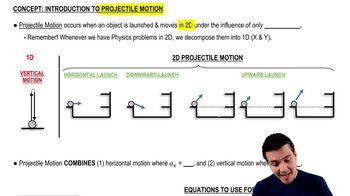
Projectile motion refers to the motion of an object that is launched into the air and is subject to gravitational forces. It can be analyzed in two dimensions: horizontal and vertical. The horizontal motion is uniform, while the vertical motion is influenced by gravity, leading to a parabolic trajectory. Understanding this concept is crucial for determining the launch angle and distance needed for the rocket to reach the hoop.
Recommended video:
Guided course
04:44
Introduction to Projectile Motion

Thrust and Forces

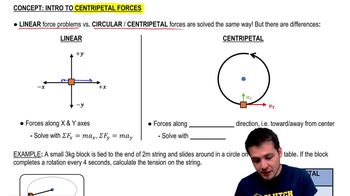
Thrust is the force exerted by the rocket engine to propel the rocket upward. In this scenario, the thrust of 8.0 N acts vertically against the force of gravity, which affects the rocket's vertical ascent. Analyzing the net forces acting on the rocket helps in calculating its vertical acceleration and the time it takes to reach the desired height of 20 m, which is essential for timing the launch correctly.
Recommended video:
Guided course
06:48
Intro to Centripetal Forces

Kinematic Equations

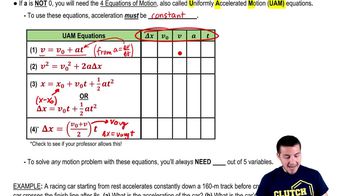
Kinematic equations describe the motion of objects under constant acceleration. They relate displacement, initial velocity, final velocity, acceleration, and time. In this problem, these equations will be used to calculate the time it takes for the rocket to ascend to the hoop's height and the horizontal distance it travels during that time, allowing for the determination of the optimal launch position.
Recommended video:
Guided course
08:25
Kinematics Equations
Related Practice
Textbook Question

A 1500 kg car takes a 50-m-radius unbanked curve at 15 m/s. What is the size of the friction force on the car?

1
views

Textbook Question

A 4.0 x 10¹⁰ kg asteroid is heading directly toward the center of the earth at a steady 20 km/s. To save the planet, astronauts strap a giant rocket to the asteroid perpendicular to its direction of travel. The rocket generates 5.0 x 10⁹ N of thrust. The rocket is fired when the asteroid is 4.0 x 10⁶ km away from earth. You can ignore the earth's gravitational force on the asteroid and their rotation about the sun. If the mission fails, how many hours is it until the asteroid impacts the earth?

4
views
Textbook Question

As a science fair project, you want to launch an 800 g model rocket straight up and hit a horizontally moving target as it passes 30 m above the launch point. The rocket engine provides a constant thrust of 15.0 N. The target is approaching at a speed of 15 m/s. At what horizontal distance between the target and the rocket should you launch?

4
views
Textbook Question

A 4.0 x 10¹⁰ kg asteroid is heading directly toward the center of the earth at a steady 20 km/s. To save the planet, astronauts strap a giant rocket to the asteroid perpendicular to its direction of travel. The rocket generates 5.0 x 10⁹ N of thrust. The rocket is fired when the asteroid is 4.0 x 10⁶ km away from earth. You can ignore the earth's gravitational force on the asteroid and their rotation about the sun.The radius of the earth is 6400 km. By what minimum angle must the asteroid be deflected to just miss the earth?

6
views