
The 10 mg bead in FIGURE CP8.69 is free to slide on a frictionless wire loop. The loop rotates about a vertical axis with angular velocity ω. If ω is less than some critical value ω꜀, the bead sits at the bottom of the spinning loop. When ω > ω꜀, the bead moves out to some angle θ. What is ω꜀ in rpm for the loop shown in the figure?
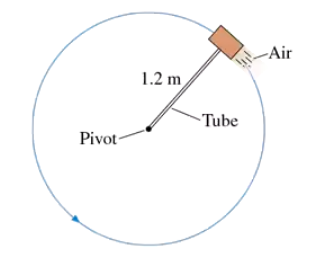
A 500 g steel block rotates on a steel table while attached to a 1.2-m-long hollow tube as shown in FIGURE CP8.70. Compressed air fed through the tube and ejected from a nozzle on the back of the block exerts a thrust force of 4.0 N perpendicular to the tube. The maximum tension the tube can withstand without breaking is 50 N. If the block starts from rest, how many revolutions does it make before the tube breaks?

Verified step by step guidance
Verified video answer for a similar problem:
Key Concepts
Newton's Second Law of Motion
Centripetal Force
Tension in the Tube
In the absence of air resistance, a projectile that lands at the elevation from which it was launched achieves maximum range when launched at a 45° angle. Suppose a projectile of mass m is launched with speed into a headwind that exerts a constant, horizontal retarding force By what percentage is the maximum range of a 0.50 kg ball reduced if ?
If a vertical cylinder of water (or any other liquid) rotates about its axis, as shown in FIGURE CP8.72, the surface forms a smooth curve. Assuming that the water rotates as a unit (i.e., all the water rotates with the same angular velocity), show that the shape of the surface is a parabola described by the equation z = (ω2 / 2g) r2. Hint: Each particle of water on the surface is subject to only two forces: gravity and the normal force due to the water underneath it. The normal force, as always, acts perpendicular to the surface.
In the absence of air resistance, a projectile that lands at the elevation from which it was launched achieves maximum range when launched at a 45° angle. Suppose a projectile of mass m is launched with speed into a headwind that exerts a constant, horizontal retarding force . Find an expression for the angle at which the range is maximum.
