
Ch 04: Kinematics in Two Dimensions
Knight Calc - Physics for Scientists and Engineers 5th Edition
Knight Calc5th EditionPhysics for Scientists and EngineersISBN: 9780137344796Not the one you use?Change textbook
Chapter 4, Problem 71b

Flywheels—rapidly rotating disks—are widely used in industry for storing energy. They are spun up slowly when extra energy is available, then decelerate quickly when needed to supply a boost of energy. A 20-cm-diameter rotor made of advanced materials can spin at 100,000 rpm. b. Suppose the rotor's angular velocity decreases by 40% over 30 s as it supplies energy. What is the magnitude of the rotor's angular acceleration? Assume that the angular acceleration is constant.

Verified step by step guidance
1
Step 1: Understand the problem. The rotor's angular velocity decreases by 40% over 30 seconds, and we need to calculate the magnitude of the angular acceleration, assuming it is constant. Angular acceleration is defined as the rate of change of angular velocity over time.
Step 2: Convert the initial angular velocity from revolutions per minute (rpm) to radians per second. Use the formula: \( \omega = \text{rpm} \times \frac{2\pi}{60} \). Here, the initial angular velocity is \( \omega_i = 100,000 \, \text{rpm} \).
Step 3: Calculate the final angular velocity after a 40% decrease. The final angular velocity \( \omega_f \) is given by \( \omega_f = \omega_i \times (1 - 0.40) \).
Step 4: Use the formula for angular acceleration: \( \alpha = \frac{\Delta \omega}{\Delta t} \), where \( \Delta \omega = \omega_f - \omega_i \) and \( \Delta t = 30 \, \text{s} \). Substitute the values of \( \omega_i \), \( \omega_f \), and \( \Delta t \) into the formula.
Step 5: Take the magnitude of the angular acceleration \( \alpha \) to ensure the result is positive, as the problem asks for the magnitude.

Verified video answer for a similar problem:

This video solution was recommended by our tutors as helpful for the problem above.
Video duration:
6m
Was this helpful?

Key Concepts

Here are the essential concepts you must grasp in order to answer the question correctly.

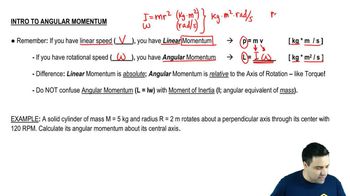
Angular Velocity

Angular velocity is a measure of how quickly an object rotates around an axis, typically expressed in radians per second or revolutions per minute (rpm). In this scenario, the rotor's initial angular velocity is crucial for calculating how much it decreases over time as it supplies energy. Understanding angular velocity helps in determining the rate of change of the rotor's rotation.
Recommended video:
Guided course
06:18
Intro to Angular Momentum

Angular Acceleration

Angular acceleration refers to the rate of change of angular velocity over time, measured in radians per second squared. It indicates how quickly an object is speeding up or slowing down its rotation. In this problem, calculating the angular acceleration is essential to understand how the rotor's speed decreases as it delivers energy, given that it is assumed to be constant during the 30 seconds.
Recommended video:
Guided course
12:12
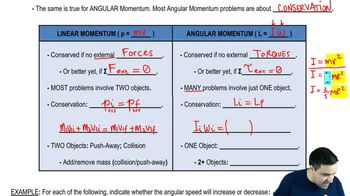
Conservation of Angular Momentum

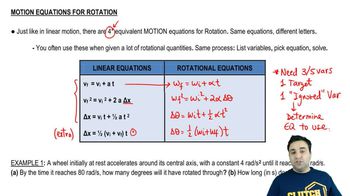
Kinematic Equations for Rotational Motion

Kinematic equations for rotational motion are analogous to linear motion equations and relate angular displacement, angular velocity, angular acceleration, and time. These equations allow us to calculate unknown variables when certain values are known. In this case, they will be used to find the angular acceleration of the rotor as it slows down, providing a mathematical framework for solving the problem.
Recommended video:
Guided course
07:18
Equations of Rotational Motion
Related Practice
Textbook Question

A 25 g steel ball is attached to the top of a 24-cm-diameter vertical wheel. Starting from rest, the wheel accelerates at 470 rad/s². The ball is released after ¾ of a revolution. How high does it go above the center of the wheel?

14
views
Textbook Question

A computer hard disk 8.0 cm in diameter is initially at rest. A small dot is painted on the edge of the disk. The disk accelerates at 600 rad/s² for ½ s, then coasts at a steady angular velocity for another ½ s. Through how many revolutions has the disk turned?

1
views
Textbook Question

Flywheels—rapidly rotating disks—are widely used in industry for storing energy. They are spun up slowly when extra energy is available, then decelerate quickly when needed to supply a boost of energy. A 20-cm-diameter rotor made of advanced materials can spin at 100,000 rpm. What is the speed of a point on the rim of this rotor?

1
views
Textbook Question

The angular velocity of a process control motor is ω = ( 20 - ½ t² ) rad/s, where t is in seconds. At what time does the motor reverse direction?

2
views
Textbook Question

The angular velocity of a process control motor is ω = ( 20 ─ ½ t² ) rad/s, where t is in seconds. Through what angle does the motor turn between t = 0 s and the instant at which it reverses direction?

1
views
Textbook Question

Communications satellites are placed in a circular orbit where they stay directly over a fixed point on the equator as the earth rotates. These are called geosynchronous orbits. The radius of the earth is 6.37 x 10⁶ m, and the altitude of a geosynchronous orbit is 3.58 x 10⁷ m (≈ 22,000 miles). What are (a) the speed and (b) the magnitude of the acceleration of a satellite in a geosynchronous orbit?