
Ch 04: Kinematics in Two Dimensions
Knight Calc - Physics for Scientists and Engineers 5th Edition
Knight Calc5th EditionPhysics for Scientists and EngineersISBN: 9780137344796Not the one you use?Change textbook
Chapter 4, Problem 68

Communications satellites are placed in a circular orbit where they stay directly over a fixed point on the equator as the earth rotates. These are called geosynchronous orbits. The radius of the earth is 6.37 x 10⁶ m, and the altitude of a geosynchronous orbit is 3.58 x 10⁷ m (≈ 22,000 miles). What are (a) the speed and (b) the magnitude of the acceleration of a satellite in a geosynchronous orbit?

Verified step by step guidance
1
Step 1: Calculate the total radius of the satellite's orbit. The total radius is the sum of the Earth's radius and the altitude of the geosynchronous orbit. Use the formula: r=Re+h, where Re is the Earth's radius and h is the altitude of the orbit.
Step 2: Determine the orbital period of the satellite. For a geosynchronous orbit, the orbital period is equal to the Earth's rotational period, which is 24 hours. Convert this time into seconds using the formula: T=24×60×60.
Step 3: Calculate the orbital speed of the satellite. Use the formula for circular orbital speed: v=2πrT, where r is the total radius of the orbit and T is the orbital period.
Step 4: Calculate the centripetal acceleration of the satellite. Use the formula: a=v2r, where v is the orbital speed and r is the total radius of the orbit.
Step 5: Verify the results conceptually. Ensure that the calculated speed and acceleration are consistent with the requirements of a geosynchronous orbit, where the satellite remains stationary relative to a point on the Earth's surface.

Verified video answer for a similar problem:

This video solution was recommended by our tutors as helpful for the problem above.
Video duration:
2m
Was this helpful?

Key Concepts

Here are the essential concepts you must grasp in order to answer the question correctly.

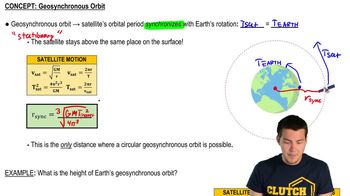
Geosynchronous Orbit

A geosynchronous orbit is a circular orbit around the Earth where a satellite's orbital period matches the Earth's rotation period, approximately 24 hours. This allows the satellite to remain fixed over a specific point on the equator, making it ideal for communication purposes. The altitude of such an orbit is about 35,786 kilometers above the Earth's surface.
Recommended video:
Guided course
04:45
Geosynchronous Orbits

Centripetal Speed

Centripetal speed is the constant speed required for an object to maintain a circular path. It is determined by the radius of the orbit and the gravitational force acting on the satellite. The formula for centripetal speed (v) in a circular orbit is v = √(GM/r), where G is the gravitational constant, M is the mass of the Earth, and r is the distance from the center of the Earth to the satellite.
Recommended video:
Guided course
06:48
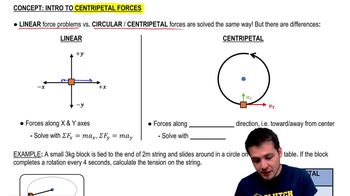
Intro to Centripetal Forces

Centripetal Acceleration

Centripetal acceleration is the acceleration directed towards the center of a circular path, necessary for an object to maintain its circular motion. It can be calculated using the formula a = v²/r, where v is the orbital speed and r is the radius of the orbit. This acceleration is crucial for understanding the forces acting on satellites in orbit.
Recommended video:
Guided course
06:48
Intro to Centripetal Forces
Related Practice
Textbook Question

A computer hard disk 8.0 cm in diameter is initially at rest. A small dot is painted on the edge of the disk. The disk accelerates at 600 rad/s² for ½ s, then coasts at a steady angular velocity for another ½ s. Through how many revolutions has the disk turned?

1
views
Textbook Question

A Ferris wheel of radius R speeds up with angular acceleration starting from rest. Find expressions for the (a) velocity and (b) centripetal acceleration of a rider after the Ferris wheel has rotated through angle ∆θ.

4
views
Textbook Question

A typical laboratory centrifuge rotates at 4000 rpm. Test tubes have to be placed into a centrifuge very carefully because of the very large accelerations. What is the acceleration at the end of a test tube that is 10 cm from the axis of rotation?

2
views
Textbook Question

A typical laboratory centrifuge rotates at 4000 rpm. Test tubes have to be placed into a centrifuge very carefully because of the very large accelerations. For comparison, what is the magnitude of the acceleration a test tube would experience if dropped from a height of 1.0 m and stopped in a 1.0-ms-long encounter with a hard floor?

1
views
Textbook Question

Flywheels—rapidly rotating disks—are widely used in industry for storing energy. They are spun up slowly when extra energy is available, then decelerate quickly when needed to supply a boost of energy. A 20-cm-diameter rotor made of advanced materials can spin at 100,000 rpm. What is the speed of a point on the rim of this rotor?

1
views
Textbook Question

Flywheels—rapidly rotating disks—are widely used in industry for storing energy. They are spun up slowly when extra energy is available, then decelerate quickly when needed to supply a boost of energy. A 20-cm-diameter rotor made of advanced materials can spin at 100,000 rpm. b. Suppose the rotor's angular velocity decreases by 40% over 30 s as it supplies energy. What is the magnitude of the rotor's angular acceleration? Assume that the angular acceleration is constant.

2
views