
Ch 04: Kinematics in Two Dimensions
Knight Calc - Physics for Scientists and Engineers 5th Edition
Knight Calc5th EditionPhysics for Scientists and EngineersISBN: 9780137344796Not the one you use?Change textbook
Chapter 4, Problem 73b

The angular velocity of a process control motor is ω = ( 20 ─ ½ t² ) rad/s, where t is in seconds. Through what angle does the motor turn between t = 0 s and the instant at which it reverses direction?

Verified step by step guidance
1
Step 1: Understand the problem. The angular velocity ω is given as a function of time: ω = 20 - (1/2)t² rad/s. The motor reverses direction when ω = 0. To find the angle θ turned by the motor, we need to integrate the angular velocity over the time interval from t = 0 to the time when ω = 0.
Step 2: Determine the time at which the motor reverses direction. Set ω = 0 and solve for t: 0 = 20 - (1/2)t². Rearrange the equation to isolate t²: t² = 40. Solve for t: t = √40 seconds.
Step 3: Write the expression for the angle θ turned by the motor. The angle θ is the integral of angular velocity ω with respect to time: θ = ∫ω dt. Substitute ω = 20 - (1/2)t² into the integral: θ = ∫(20 - (1/2)t²) dt.
Step 4: Perform the integration. Break the integral into two parts: θ = ∫20 dt - ∫(1/2)t² dt. The first term integrates to 20t, and the second term integrates to -(1/6)t³. Combine these results: θ = 20t - (1/6)t³.
Step 5: Evaluate θ over the interval from t = 0 to t = √40. Substitute the limits of integration into the expression for θ: θ = [20(√40) - (1/6)(√40)³] - [20(0) - (1/6)(0)³]. Simplify the expression to find the total angle turned by the motor.

Verified video answer for a similar problem:

This video solution was recommended by our tutors as helpful for the problem above.
Video duration:
2m
Was this helpful?

Key Concepts

Here are the essential concepts you must grasp in order to answer the question correctly.

Angular Velocity

Angular velocity (ω) is a measure of how quickly an object rotates around an axis, expressed in radians per second. In this context, the angular velocity of the motor is given as a function of time, indicating that it changes as time progresses. Understanding angular velocity is crucial for determining how the motor's speed varies and for calculating the total angle turned over a specific time interval.
Recommended video:
Guided course
06:18
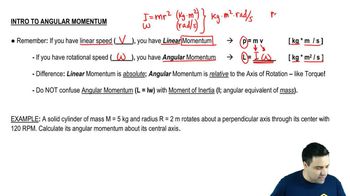
Intro to Angular Momentum

Angular Displacement

Angular displacement refers to the angle through which an object has rotated about a specific axis, measured in radians. To find the total angle the motor turns, we need to integrate the angular velocity function over the time interval from t = 0 s to the time when the motor reverses direction. This concept is essential for connecting the motor's changing speed to the total angle it covers.
Recommended video:
Guided course
14:03
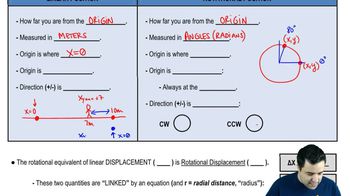
Rotational Position & Displacement

Reversal of Direction

The reversal of direction in a rotating object occurs when its angular velocity changes sign, indicating a transition from clockwise to counterclockwise rotation or vice versa. In this problem, we need to determine the time at which the angular velocity becomes zero (ω = 0) to find when the motor reverses direction. This point is critical for calculating the angle turned during the specified time interval.
Recommended video:
09:49
Direction of Current in Loop Equations