Ch 02: Kinematics in One Dimension
Knight Calc - Physics for Scientists and Engineers 5th Edition
Knight Calc5th EditionPhysics for Scientists and EngineersISBN: 9780137344796Not the one you use?Change textbook
Chapter 2, Problem 47

You are driving to the grocery store at 20 m/s. You are 110 m from an intersection when the traffic light turns red. Assume that your reaction time is 0.50 s and that your car brakes with constant acceleration. What magnitude braking acceleration will bring you to a stop exactly at the intersection?

Verified step by step guidance
1
Determine the distance traveled during the reaction time. Use the formula for distance traveled at constant velocity: d=vt, where v is the velocity (20 m/s) and t is the reaction time (0.50 s).
Subtract the distance traveled during the reaction time from the total distance to the intersection to find the distance over which the car must decelerate. Use the formula: d=dtotal-dreaction, where dtotal is 110 m.
Use the kinematic equation to relate the remaining distance, initial velocity, final velocity, and acceleration: d=vit+12at2. Here, vi is the initial velocity (20 m/s), vf is the final velocity (0 m/s), and d is the remaining distance.
Rearrange the kinematic equation to solve for the acceleration a. Use the formula: a=-vi22d, where d is the remaining distance and vi is the initial velocity.
Substitute the known values into the formula for acceleration and simplify to find the magnitude of the braking acceleration. Remember to take the absolute value of the result since the problem asks for the magnitude.

Verified video answer for a similar problem:

This video solution was recommended by our tutors as helpful for the problem above.
Video duration:
7m
Was this helpful?

Key Concepts

Here are the essential concepts you must grasp in order to answer the question correctly.

Kinematics

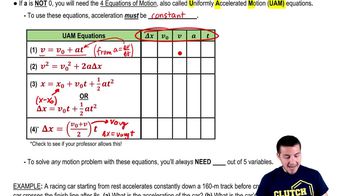
Kinematics is the branch of mechanics that deals with the motion of objects without considering the forces that cause the motion. It involves concepts such as displacement, velocity, and acceleration. In this scenario, understanding kinematics is essential to analyze the car's motion as it approaches the intersection and to calculate the necessary braking distance.
Recommended video:
Guided course
08:25
Kinematics Equations

Acceleration

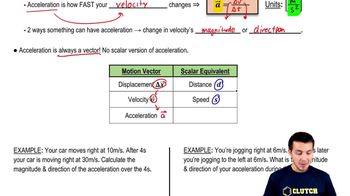
Acceleration is defined as the rate of change of velocity of an object over time. It can be positive (speeding up) or negative (slowing down, also known as deceleration). In this problem, the braking acceleration is crucial to determine how quickly the car can stop before reaching the intersection, given the initial speed and the distance to the stop.
Recommended video:
Guided course
05:47
Intro to Acceleration

Reaction Time

Reaction time is the delay between the perception of a stimulus and the initiation of a response. In driving scenarios, it affects how quickly a driver can respond to changes, such as a traffic light turning red. In this question, the 0.50 s reaction time must be accounted for when calculating the total distance traveled before the brakes are applied, impacting the required braking acceleration.
Recommended video:
Guided course
08:01
Newton's Third Law & Action-Reaction Pairs