
Ch 02: Kinematics in One Dimension
Knight Calc - Physics for Scientists and Engineers 5th Edition
Knight Calc5th EditionPhysics for Scientists and EngineersISBN: 9780137344796Not the one you use?Change textbook
Chapter 2, Problem 48a

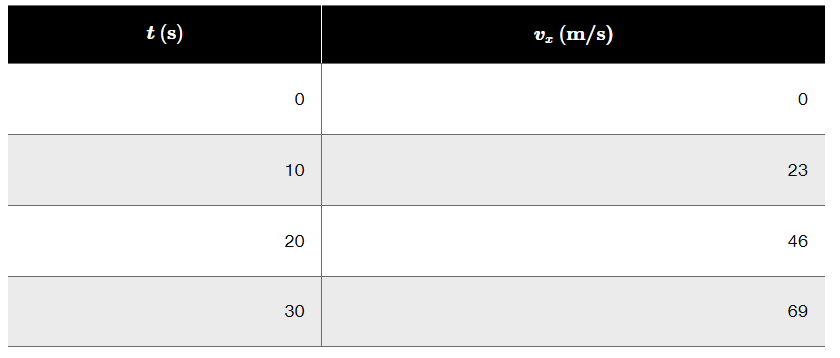
The takeoff speed for an Airbus A320 jetliner is 80 m/s. Velocity data measured during takeoff are as shown. Is the jetliner's acceleration constant during takeoff? Explain.

Verified step by step guidance
1
Step 1: Recall the definition of acceleration. Acceleration is the rate of change of velocity with respect to time, mathematically expressed as \( a = \frac{\Delta v}{\Delta t} \), where \( \Delta v \) is the change in velocity and \( \Delta t \) is the change in time.
Step 2: Use the velocity data provided in the table to calculate the acceleration for each time interval. For example, between \( t = 0 \) and \( t = 10 \), \( \Delta v = v_{x}(10) - v_{x}(0) \) and \( \Delta t = 10 - 0 \). Repeat this calculation for the intervals \( t = 10 \) to \( t = 20 \), and \( t = 20 \) to \( t = 30 \).
Step 3: Compare the calculated acceleration values for each interval. If the acceleration values are the same for all intervals, then the jetliner's acceleration is constant. If the values differ, the acceleration is not constant.
Step 4: Interpret the results. If the acceleration is constant, it indicates uniform motion under constant force. If the acceleration varies, it suggests changes in the forces acting on the jetliner during takeoff.
Step 5: Conclude whether the jetliner's acceleration is constant during takeoff based on the comparison of acceleration values calculated in Step 3.

Key Concepts

Here are the essential concepts you must grasp in order to answer the question correctly.

Acceleration

Acceleration is defined as the rate of change of velocity over time. It can be calculated using the formula a = (v_f - v_i) / t, where v_f is the final velocity, v_i is the initial velocity, and t is the time interval. If the acceleration is constant, the velocity will change linearly over time, resulting in a straight line when plotted on a graph.
Recommended video:
Guided course
05:47
Intro to Acceleration

Velocity

Velocity is a vector quantity that describes the rate of change of an object's position with respect to time, including both speed and direction. In the context of the Airbus A320, the velocity data shows how the speed of the jetliner increases at different time intervals during takeoff. Analyzing these values helps determine if the acceleration is constant or variable.
Recommended video:
Guided course
7:27
Escape Velocity

Graphical Analysis

Graphical analysis involves interpreting data presented in graphical form, such as velocity vs. time graphs. By plotting the given velocity data against time, one can visually assess whether the relationship is linear, indicating constant acceleration, or nonlinear, suggesting varying acceleration. This method is crucial for understanding the dynamics of the jetliner during takeoff.
Recommended video:
Guided course
05:00
Dimensional Analysis
Related Practice
Textbook Question

A cheetah spots a Thomson's gazelle, its preferred prey, and leaps into action, quickly accelerating to its top speed of 30 m/s, the highest of any land animal. However, a cheetah can maintain this extreme speed for only 15 s before having to let up. The cheetah is 170 m from the gazelle as it reaches top speed, and the gazelle sees the cheetah at just this instant. With negligible reaction time, the gazelle heads directly away from the cheetah, accelerating at 4.6 m/s² for 5.0 s, then running at constant speed. Does the gazelle escape? If so, by what distance is the gazelle in front when the cheetah gives up?

1
views
Textbook Question

You are driving to the grocery store at 20 m/s. You are 110 m from an intersection when the traffic light turns red. Assume that your reaction time is 0.50 s and that your car brakes with constant acceleration. What magnitude braking acceleration will bring you to a stop exactly at the intersection?

1
views
Textbook Question

Draw position, velocity, and acceleration graphs for the ball shown in FIGURE P2.44. See Problem 43 for more information.

2
views
Textbook Question

FIGURE P2.45 shows a set of kinematic graphs for a ball rolling on a track. All segments of the track are straight lines, but some may be tilted. Draw a picture of the track and also indicate the ball's initial condition.

2
views
Textbook Question

You're driving down the highway late one night at 20 m/s when a deer steps onto the road 35 m in front of you. Your reaction time before stepping on the brakes is 0.50 s, and the maximum deceleration of your car is 10 m/s². How much distance is between you and the deer when you come to a stop?

1
views
Textbook Question

A car starts from rest at a stop sign. It accelerates at 4.0 m/s² for 6.0 s, coasts for 2.0 s, and then slows down at a rate of 3.0 m/s² for the next stop sign. How far apart are the stop signs?

2
views