Ch 02: Kinematics in One Dimension
Knight Calc - Physics for Scientists and Engineers 5th Edition
Knight Calc5th EditionPhysics for Scientists and EngineersISBN: 9780137344796Not the one you use?Change textbook
Chapter 2, Problem 45

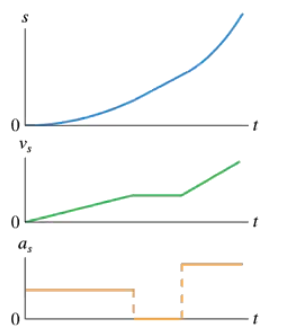
FIGURE P2.45 shows a set of kinematic graphs for a ball rolling on a track. All segments of the track are straight lines, but some may be tilted. Draw a picture of the track and also indicate the ball's initial condition.

Verified step by step guidance
1
Analyze the given kinematic graphs: Start by carefully examining the position-time, velocity-time, and acceleration-time graphs provided in FIGURE P2.45. Identify key features such as slopes, intercepts, and changes in the graphs to understand the motion of the ball.
Interpret the position-time graph: The slope of the position-time graph represents the velocity of the ball. A straight line with a positive slope indicates constant velocity, while a curved line indicates acceleration or deceleration. Use this information to infer the shape and tilt of the track in different segments.
Interpret the velocity-time graph: The slope of the velocity-time graph represents the acceleration of the ball. A horizontal line indicates constant velocity (no acceleration), while a sloped line indicates constant acceleration or deceleration. Use this to determine whether the track is flat, inclined, or declining in each segment.
Interpret the acceleration-time graph: The acceleration-time graph provides direct information about the ball's acceleration. A zero value indicates no acceleration (flat track or constant velocity), while a positive or negative value indicates acceleration or deceleration due to an inclined or declined track.
Combine the information: Use the insights from all three graphs to sketch the track. For example, a flat position-time graph corresponds to a flat track, while a curved position-time graph with increasing slope corresponds to a downward incline. Also, indicate the ball's initial condition (e.g., initial position, velocity, and whether it starts from rest or with an initial push).

Verified video answer for a similar problem:

This video solution was recommended by our tutors as helpful for the problem above.
Video duration:
3m
Was this helpful?

Key Concepts

Here are the essential concepts you must grasp in order to answer the question correctly.

Kinematics

Kinematics is the branch of mechanics that describes the motion of objects without considering the forces that cause the motion. It involves concepts such as displacement, velocity, and acceleration, which are essential for analyzing how the ball moves along the track. Understanding kinematic graphs helps visualize the relationship between these quantities over time.
Recommended video:
Guided course
08:25
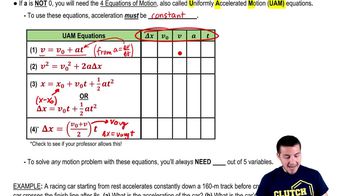
Kinematics Equations

Graph Interpretation

Interpreting kinematic graphs involves analyzing the graphical representation of an object's motion. Different types of graphs, such as position vs. time, velocity vs. time, and acceleration vs. time, provide insights into the object's behavior. For instance, the slope of a position vs. time graph indicates velocity, while the area under a velocity vs. time graph represents displacement.
Recommended video:
Guided course
07:32
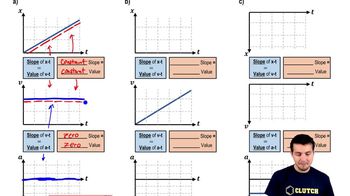
Graphing Position, Velocity, and Acceleration Graphs

Initial Conditions

Initial conditions refer to the state of an object at the beginning of a motion analysis, including its initial position, velocity, and acceleration. These conditions are crucial for accurately predicting future motion and for drawing the track and the ball's starting point. In this context, identifying the ball's initial condition helps establish a reference point for understanding its subsequent movement along the track.
Recommended video:
Related Practice