
Ch 01: Concepts of Motion
Knight Calc - Physics for Scientists and Engineers 5th Edition
Knight Calc5th EditionPhysics for Scientists and EngineersISBN: 9780137344796Not the one you use?Change textbook
Chapter 1, Problem 2a

You are watching a jet ski race. A racer speeds up from rest to 70 mph in 10 s, then continues at a constant speed. Draw a basic motion diagram of the jet ski, using s from the video, from its start until 10 s after reaching top speed.

Verified step by step guidance
1
Step 1: Understand the problem. The jet ski starts from rest, accelerates uniformly to 70 mph in 10 seconds, and then continues at a constant speed. A motion diagram represents the position of the object at equal time intervals, showing changes in velocity and acceleration.
Step 2: Break the motion into two phases: (1) acceleration phase (0 to 10 seconds) and (2) constant speed phase (10 to 20 seconds). During the acceleration phase, the spacing between the dots in the motion diagram will increase because the jet ski is speeding up. During the constant speed phase, the spacing between the dots will remain uniform.
Step 3: Calculate the acceleration during the first phase using the formula: a=ΔvΔt. Here, Δv is the change in velocity (70 mph converted to m/s) and Δt is 10 seconds.
Step 4: For the motion diagram, represent the acceleration phase with dots that start close together and gradually spread out as the jet ski speeds up. For the constant speed phase, represent it with evenly spaced dots, as the velocity remains constant.
Step 5: Label the motion diagram with time intervals (e.g., 0 s, 2 s, 4 s, etc.) and indicate the transition point at 10 seconds where the motion changes from acceleration to constant speed. This will help visualize the jet ski's motion over the entire 20-second period.

Verified video answer for a similar problem:

This video solution was recommended by our tutors as helpful for the problem above.
Video duration:
2m
Was this helpful?

Key Concepts

Here are the essential concepts you must grasp in order to answer the question correctly.

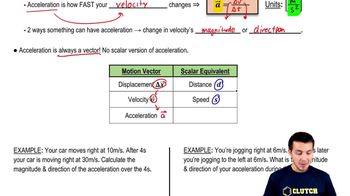
Acceleration

Acceleration is the rate of change of velocity of an object over time. In this scenario, the jet ski accelerates from rest to 70 mph in 10 seconds, indicating a positive acceleration. This concept is crucial for understanding how the speed of the jet ski increases during the initial phase of the race.
Recommended video:
Guided course
05:47
Intro to Acceleration

Constant Velocity

Constant velocity occurs when an object moves at a fixed speed in a straight line without changing direction. After reaching 70 mph, the jet ski maintains this speed, which means its acceleration becomes zero. Understanding this concept helps in analyzing the motion diagram, as the jet ski will have a uniform motion after the initial acceleration phase.
Recommended video:
Guided course
08:59
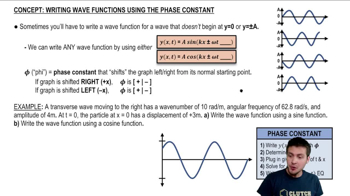
Phase Constant of a Wave Function

Motion Diagrams

A motion diagram visually represents an object's position at various points in time, often using dots to indicate the object's location at regular intervals. In this case, the motion diagram will show the jet ski's initial acceleration phase and then a series of evenly spaced dots during the constant speed phase, illustrating the change in motion over the specified time.
Recommended video:
Guided course
08:07
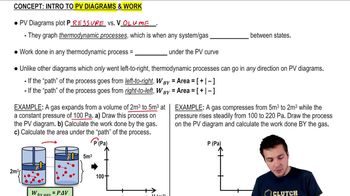
Work and PV Diagrams